The mental and social cost of MTB vs gravel and road cycling
- Mtb life
- September 22, 2026
In recent years, some riders who grew up with all-mountain, freeride and exploring by mountain bike seem to have moved towards gravel and road cycling. Their appetite for riding, hard effort and mountains may be undiminished. What has changed, perhaps, is their willingness to take on the mental, organisational and social cost of technical mountain biking.
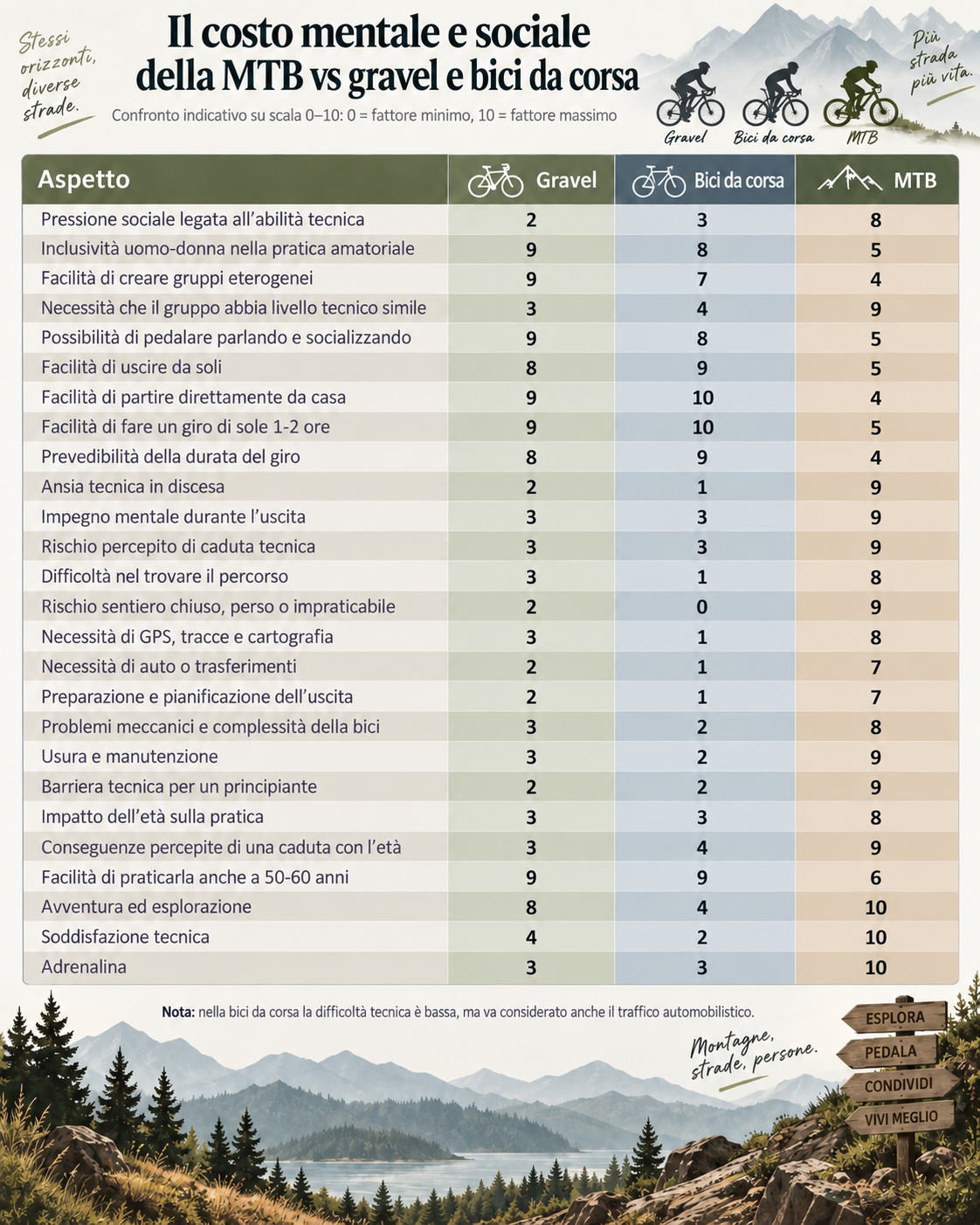
| Aspect | Gravel | Road cycling | All-mountain / freeride MTB |
|---|---|---|---|
| Technical anxiety on descents | 2 | 1 | 9 |
| Perceived risk of a technical crash | 3 | 3 | 9 |
| Difficulty finding the route | 3 | 1 | 8 |
| Risk of a closed, lost or impassable trail | 2 | 0 | 9 |
| Need for GPS, tracks and maps | 3 | 1 | 8 |
| Ease of riding straight from home | 9 | 10 | 4 |
| Need for a car or transfers | 2 | 1 | 7 |
| Ride preparation and planning | 2 | 1 | 7 |
| Mechanical problems and bike complexity | 3 | 2 | 8 |
| Wear and maintenance | 3 | 2 | 9 |
| Mental effort during the ride | 3 | 3 | 9 |
| Ease of riding alone | 8 | 9 | 5 |
| Ease of fitting in a 1–2 hour ride | 9 | 10 | 5 |
| Predictability of ride duration | 8 | 9 | 4 |
| Technical barrier for a beginner | 2 | 2 | 9 |
| Impact of age on participation | 3 | 3 | 8 |
| Perceived consequences of a crash with age | 3 | 4 | 9 |
| Ease of continuing in your 50s and 60s | 9 | 9 | 6 |
| Ease of bringing together mixed-ability groups | 9 | 7 | 4 |
| Inclusion of men and women in recreational riding | 9 | 8 | 5 |
| Need for similar technical ability within the group | 3 | 4 | 9 |
| Social pressure around technical ability | 2 | 3 | 8 |
| Opportunities to chat and socialise while riding | 9 | 8 | 5 |
| Adventure and exploration | 8 | 4 | 10 |
| Technical satisfaction | 4 | 2 | 10 |
| Adrenaline | 3 | 3 | 10 |
Road cycling note: technical demands can be low, but the risk and stress associated with motor traffic need to be considered separately.
The mental cost of technical mountain biking
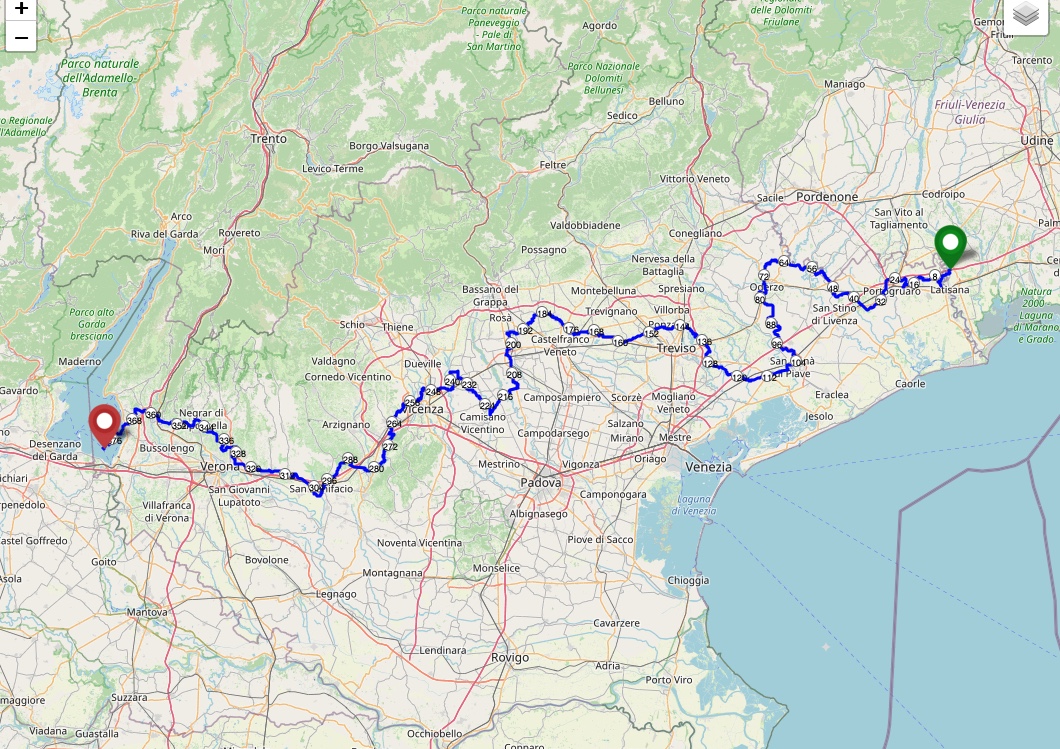
An all-mountain ride often starts the evening before. You choose a route, check the GPX track and try to establish whether the trail still matches its description. A line on a screen tells you nothing about a recent landslide, an abandoned section or trees brought down by a storm.
Then there is the weather, the technical difficulty and the ability of everyone coming along. Is each rider comfortable with exposure? Are there escape routes if someone gets tired? Do the estimated riding times make sense for the slowest person? If driving is involved, there are lifts, bike space and departure times to arrange. We have already made quite a few decisions before turning a pedal.
For a long time, this was part of the pleasure of mountain biking. Studying a map, linking two valleys, finding out where an old track went: curiosity was what made the ride happen. That complexity still has its appeal. But I can understand someone who, after a week full of decisions, simply wants to ride on Sunday.
The table describes that particular comparison: MTB on technical trails, gravel on relatively smooth tracks and recreational road riding. It cannot describe every outing. A familiar MTB loop near home can take almost no organising, while a remote gravel crossing may demand careful mapping, preparation and plenty of spare time.
Gravel and road cycling: riding from home changes everything
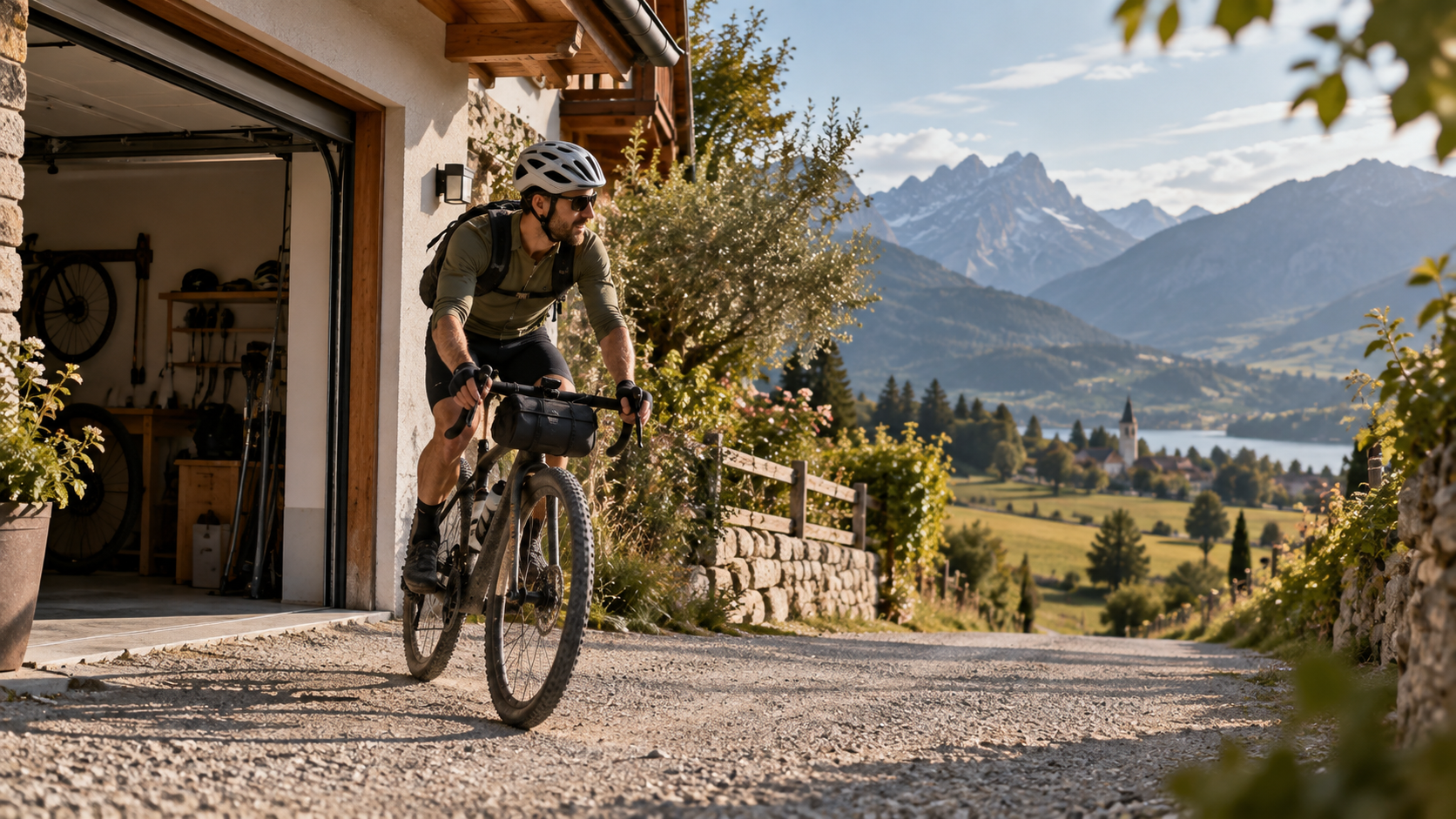
Open the garage, get on the bike and choose a direction. Ride for one, two or four hours, then roll straight back home. Where the local terrain allows it, gravel and road cycling offer a simplicity that can matter more than any discussion about equipment.
Two free hours can become almost two hours of riding. On an MTB outing that involves a transfer, the same time can disappear into loading the car, driving to a car park, getting ready and travelling back. The route itself may also be harder to predict: when a trail does not go through, the detour can cost much more than a few minutes.
That difference matters when riding alone, too. Familiar routes, clear junctions and ways to shorten a loop make a last-minute outing easier. You do not necessarily need to find someone with an entire day free. Riders living beside a good trail network can enjoy the same freedom on a mountain bike; those who always have to drive feel the extra burden much more.
Technical anxiety in MTB and the fear of getting hurt
Physical fatigue and mental fatigue are different things. You can happily contemplate 80 or 100 kilometres, with 1,500 or 2,000 metres of climbing, and still have no desire to descend rock gardens, ledges and tight switchbacks.
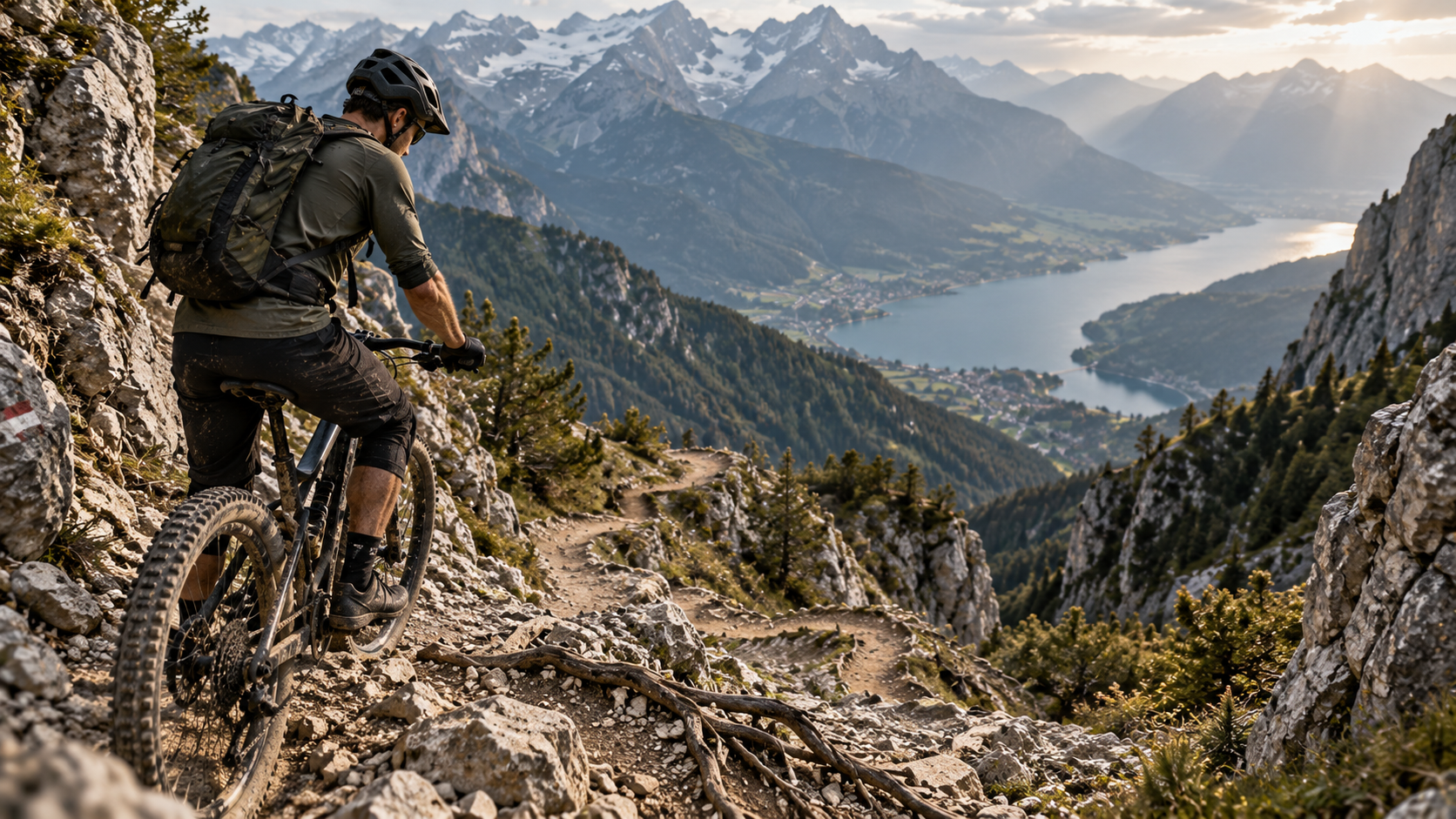
On an exposed section, a steep chute or wet roots, the question changes. It is no longer just how much energy you have left, but how much room there is for error. Reading the line, controlling the brakes, keeping your balance and managing fear all demand sustained attention. When a mistake could mean a serious crash, that tension can start well before the obstacle itself.
Gravel riding on smoother surfaces can leave you physically exhausted with a lower average level of mental tension than this kind of MTB. The effort remains, but there are fewer demanding technical decisions. That distinction helps explain the move from MTB to gravel without dismissing it as an unwillingness to work hard.
A gravel bike does not make every surface easy, of course. A rough descent can be very demanding, and speed and conditions change everything. Road riding also requires handling skills, particularly on descents and in a group. The table expresses perceptions in different settings, not the probability of an accident.
Ageing mountain bikers and a changing relationship with risk
Riders who were in their twenties or thirties during the all-mountain and freeride boom of the 2000s may now be in their forties, fifties or sixties. That does not mean they have lost their handling skills. Experience can bring precision, better judgement and the confidence to walk a section when it does not feel right.
What can change is the balance between risk and reward. At twenty-five, you might have thought of a crash as a knock you would simply deal with. At fifty, your thoughts may go straight to work, people who depend on you and what several weeks off would mean. This is not a rule about the physical effects of age. It is also about the different place an unexpected setback occupies in everyday life.
Gravel and road cycling can still provide very hard training without necessarily involving the same technical exposure. Equally, you can keep riding demanding MTB trails in your sixties if that is what you enjoy and can manage. The point is being able to change priorities without feeling like a lesser rider.
MTB maintenance and the work behind a ride
There is also the work that never appears in the photographs. Suspension, pivots, brakes, tyres and wheels need attention on a mountain bike ridden over demanding terrain. Mud, impacts and long descents mean checks, wear and sometimes workshop appointments. A noise that appears on Saturday evening can put Sunday’s plans in doubt.
Gravel and road bikes have breakdowns, consumable parts and sometimes very sophisticated components of their own. But for comparable recreational use, removing rear suspension and some of the punishment the bike takes can simplify ownership. The cost is not just financial: it includes the time and attention needed to have a bike ready when we finally have a chance to ride.
MTB, gravel and the challenge of finding a compatible group
In technical mountain biking, differences in ability can shape the whole day. A highly skilled rider and someone who lacks confidence downhill may have identical fitness but want incompatible routes. The section one considers the highlight can mean half an hour of anxiety, walking and feeling responsible for holding everyone up for the other.
Waiting at the bottom helps, but it does not always solve the problem. The obstacle is still there, and each rider has to negotiate it. On smoother gravel routes, it is often easier to adjust speed, distance and climbing. You shorten the loop, ease the pace or choose a gentler climb. Differences remain, but there are more ways to accommodate them without splitting up.
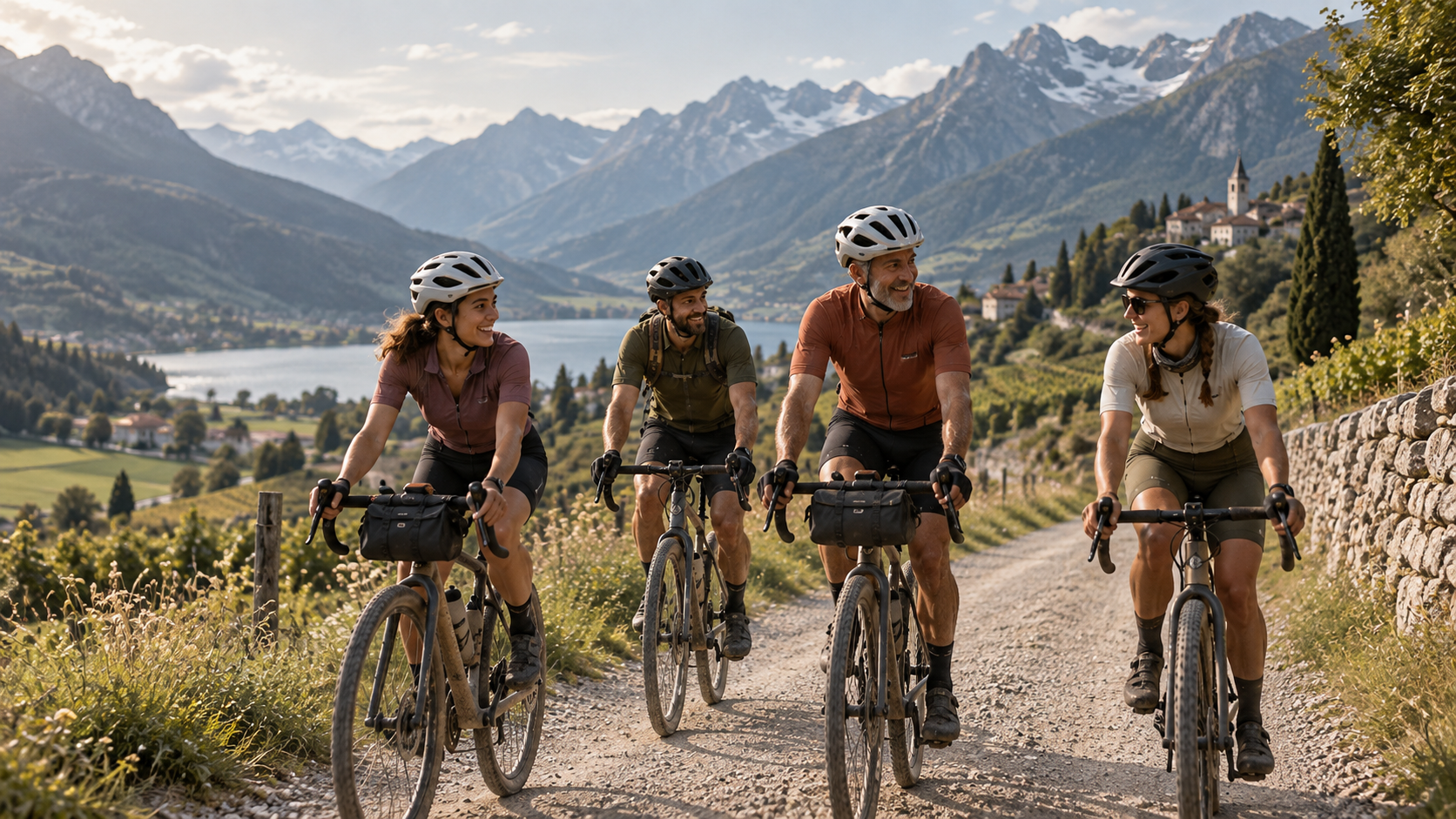
That makes mixed-ability groups easier to organise and leaves room for conversation where conditions allow. It does not mean riding side by side everywhere or ignoring other trail and road users. It means more of the outing can be spent together, rather than only meeting at junctions. A gravel group can still be unwelcoming if every ride becomes a race; the people always matter.
Gravel riding and participation by men and women
The inclusion score in the table concerns barriers to joining in, not anyone’s ability. Technical MTB and freeride have often had a predominantly male culture built around handling skills, risk, clearing difficult features and comparing what riders can do. That is not the whole story of those disciplines, but it can influence how newcomers are welcomed.
In a group where what counts most is what you can ride down, a beginner may feel constantly assessed. That barrier can affect anyone, and it may make joining harder for women in settings where they are already underrepresented. There is no reason to attribute it to women having less technical ability.
Gravel rides with accessible routes and an agreed pace lower the initial technical threshold. They can make it easier for couples, mixed groups and people with different backgrounds to ride together. A welcoming MTB group with suitable routes and genuine freedom to walk can do this very well too. The bike can reduce some barriers; the group’s attitude determines whether the others stay in place.
Group pressure on technical MTB trails
The group reaches a rock step. Someone rides it almost without slowing down, another studies the line, and one person gets off. Nobody says a word, yet the thought can still appear: “Everyone else is doing it. I should be able to as well.”
Pressure does not have to be spoken to exist. Sometimes it comes simply from wanting to belong. A rider may attempt something without feeling committed, or walk it and carry a sense of inadequacy into the rest of the day.
On smooth gravel routes, these public tests of technical ability are generally less frequent. You can be tired or slow without repeatedly having to make a visible choice between riding a feature and putting a foot down. That contributes to a more relaxed outing. In MTB, genuinely respecting someone who walks, without jokes or persuasion, can take a great deal of pressure out of the day.
Gravel has inherited some of the all-mountain spirit
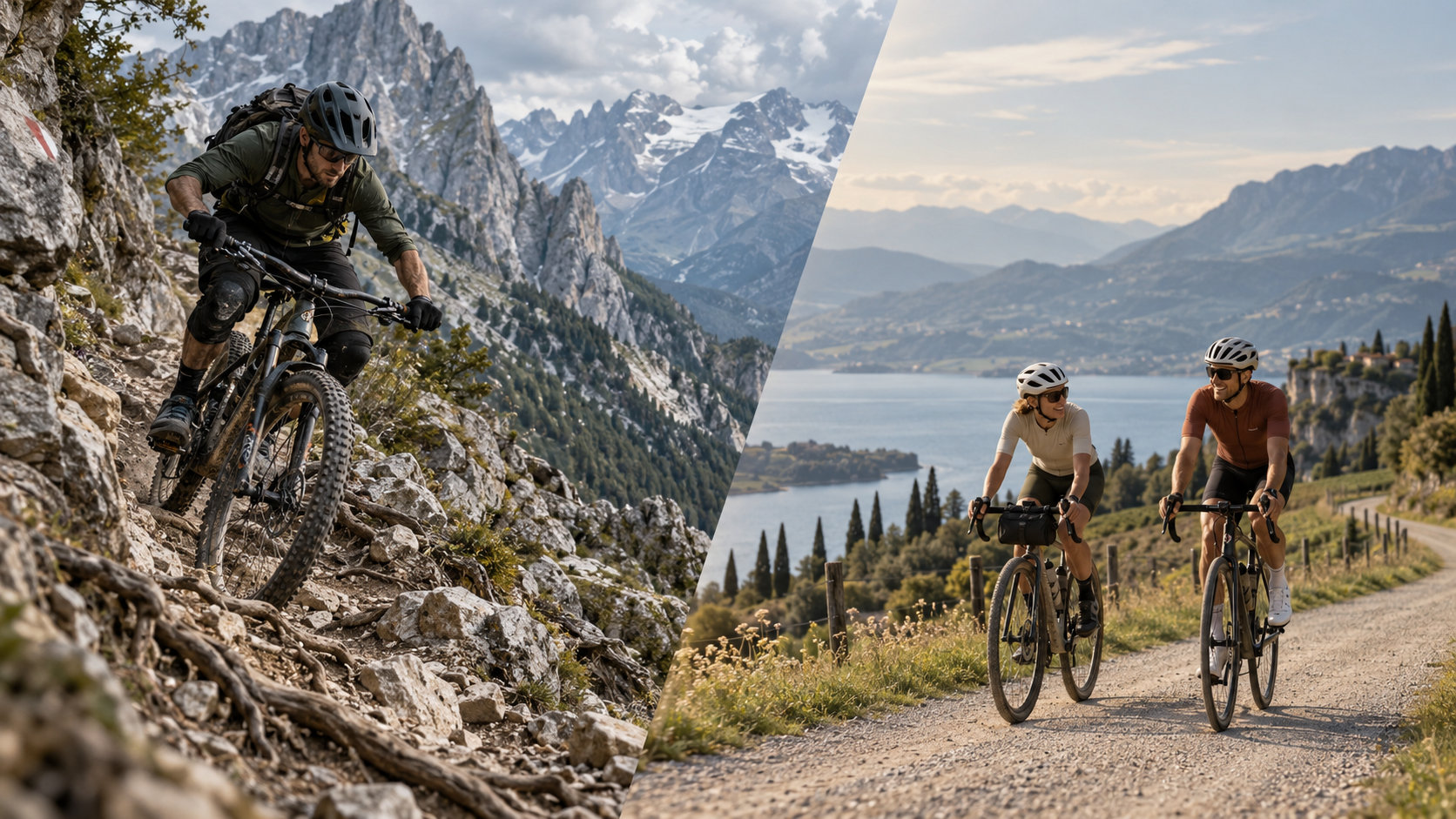
This is perhaps the most interesting part of the MTB vs gravel comparison. For some cyclists, gravel preserves exactly what first drew them to all-mountain riding: exploring, crossing mountains and valleys, linking quiet roads, discovering new places and spending long days outside without a competitive goal.
The journey was the centre of the day. A technical descent could be a wonderful part of it, but it was not necessarily the reason to leave home. If those same riders now seek a gravel road over a pass, a long loop through villages or a crossing with bikepacking bags, the continuity is clear. Their preferred terrain has changed; the desire taking them outside may not have.
On suitable routes, gravel removes much of the technical difficulty and can simplify the organisation while keeping that sense of exploration. A bikepacking trip still takes preparation, but it need not revolve around whether everyone will be able to ride a particular descent.
Our ideas for cycling trips and holidays (in Italian) bring different kinds of riding together because the desire to travel through a landscape belongs to no single discipline. For riders who valued that above all, gravel can feel like a natural continuation of their mountain biking story.
The polarisation of modern mountain biking
One possible interpretation of MTB’s evolution is a gradual polarisation. On one side, e-MTB, enduro, trail riding, bike parks and technically demanding terrain have become very visible. On the other, some riders whose main interest was touring and exploration have found an appealing home in gravel, road cycling and bikepacking.
This is an interpretation, not a division established by data or a complete account of cycling. Cross-country still exists, as does mountain bike touring, and an e-MTB can be an excellent way to explore at an easy pace. Many people use several kinds of bike and choose according to the day, without needing to belong to a single camp.
Still, this perspective helps explain why the comparison between mountain biking and gravel is about more than the performance of the bike. If one kind of riding puts the descent at the centre and another makes a long shared journey easier, they can appeal to different wishes within the same person at different stages of life.
From MTB to gravel: the desire to ride remains
I would not read every move to gravel as giving something up. The appetite for hard effort, seeing what lies beyond a pass and coming home late with dusty legs may be entirely intact. What has faded is the willingness to arrange transfers, check uncertain trails, manage fear and find companions with matching technical skills.
Demanding mountain biking still offers a riding satisfaction and intensity that are hard to replace. For those who seek them, the cost makes sense. For others, gravel now keeps enough adventure to make them want another ride while asking less of them mentally, logistically and socially before they can begin. Sometimes that is enough to decide which bike comes out of the garage.