Mountain bike levels: riding technique, strength and endurance
- Guide mtb, Mtb life
- February 10, 2020
What’s your mountain bike level?
Can I finish this ride? Will the climb wear me out? Can I ride the descent without constantly putting a foot down? Distance and elevation gain only tell part of the story. A short trail can be highly technical, while a long climb up a forest road may mainly test your endurance.
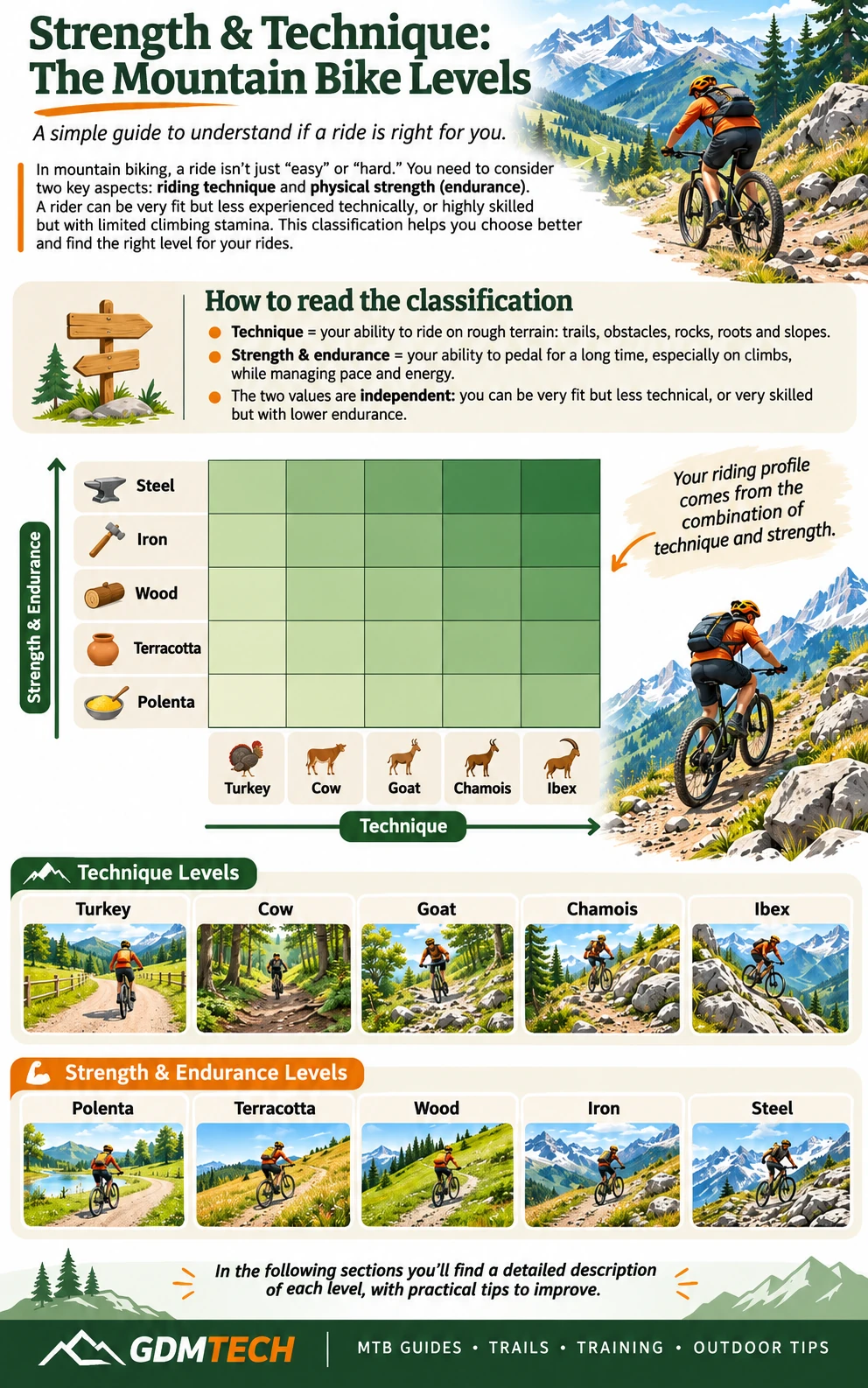
Turbolince rates two abilities separately: riding technique, from bike control to choosing a line through rocks and roots, and physical strength and endurance, from climbing to pacing a long ride. You might climb like a racer and still be learning how to descend. Use the scale to assess your own riding. For trail difficulty, consult local guides or official ratings such as those from the Italian Alpine Club (CAI).
The five levels of MTB riding technique
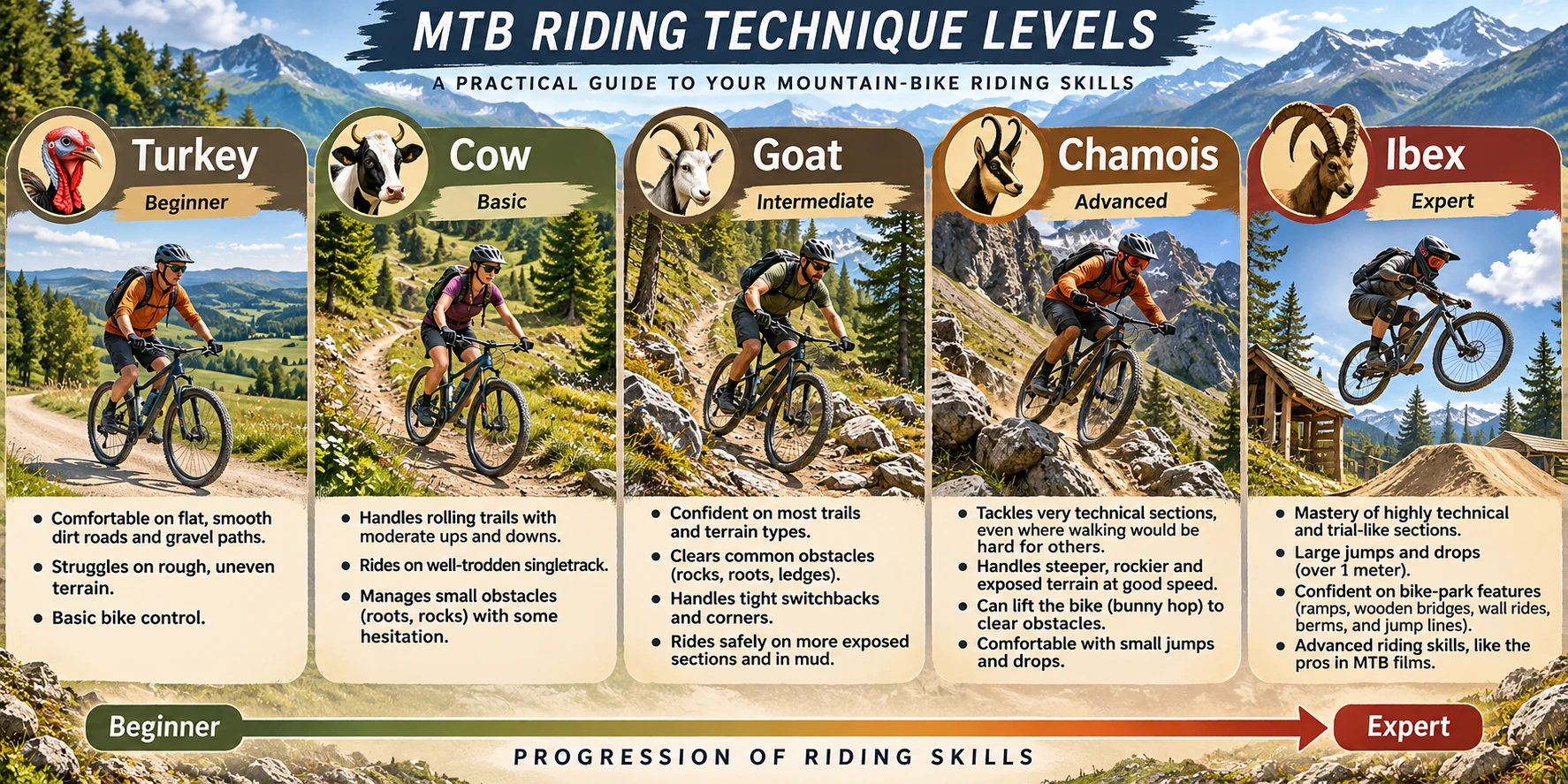
Judge your technique by how consistently you stay in control, choose a line and adapt to changing surfaces.
T1 – Turkey
You’re comfortable on bike paths, dirt roads and smooth trails. Roots, rocks and steeper slopes make you tense up. To improve: on flat ground away from traffic, practise riding out of the saddle, keeping the pedals level on descents, modulating both brakes and weaving through cones spaced 3–4 m apart. Look ahead.
T2 – Cow
You ride easy, flowing singletrack and rolling terrain. Roots and small steps may still make you stop or put a foot down. To improve: practise shifting your weight and rolling over low, stable obstacles at low speed. Progress once you can repeat the move in control.
T3 – Goat
You can handle rocks, roots, tight switchbacks and berms on typical mountain trails. You adapt on wet or muddy ground and recognise when to walk a section. To improve: practise braking before corners, choosing lines and moving dynamically on the bike. An advanced lesson or a bike park session on suitable trails can help.
T4 – Chamois
Steeps, rock gardens, steps and technical climbs are familiar. You can unweight or lift the wheels, bunny hop and handle small jumps and drops. To improve: work on precision and repeatability. Build jump, drop and trials skills gradually in designated areas, ideally with a qualified coach and suitable protection.
T5 – Ibex
You ride advanced bike park lines, complex trials features, elevated wooden trails, big jumps and demanding drops when conditions and preparation allow. To improve: practise consistently, work on weak points with a coach and leave a margin for error.
MTB technique at a glance
| Level | Profile | Typical terrain |
|---|---|---|
| T1 | Turkey | Smooth dirt roads and bike paths |
| T2 | Cow | Easy singletrack and small obstacles |
| T3 | Goat | Trails with rocks, roots and switchbacks |
| T4 | Chamois | Rock gardens, steeps and small drops |
| T5 | Ibex | Advanced lines, large jumps and demanding features |
The five levels of MTB strength and endurance
Fitness here includes aerobic endurance, pacing and recovery as well as muscular strength. The distances, durations and elevation gains are approximate and refer mainly to unassisted mountain biking.
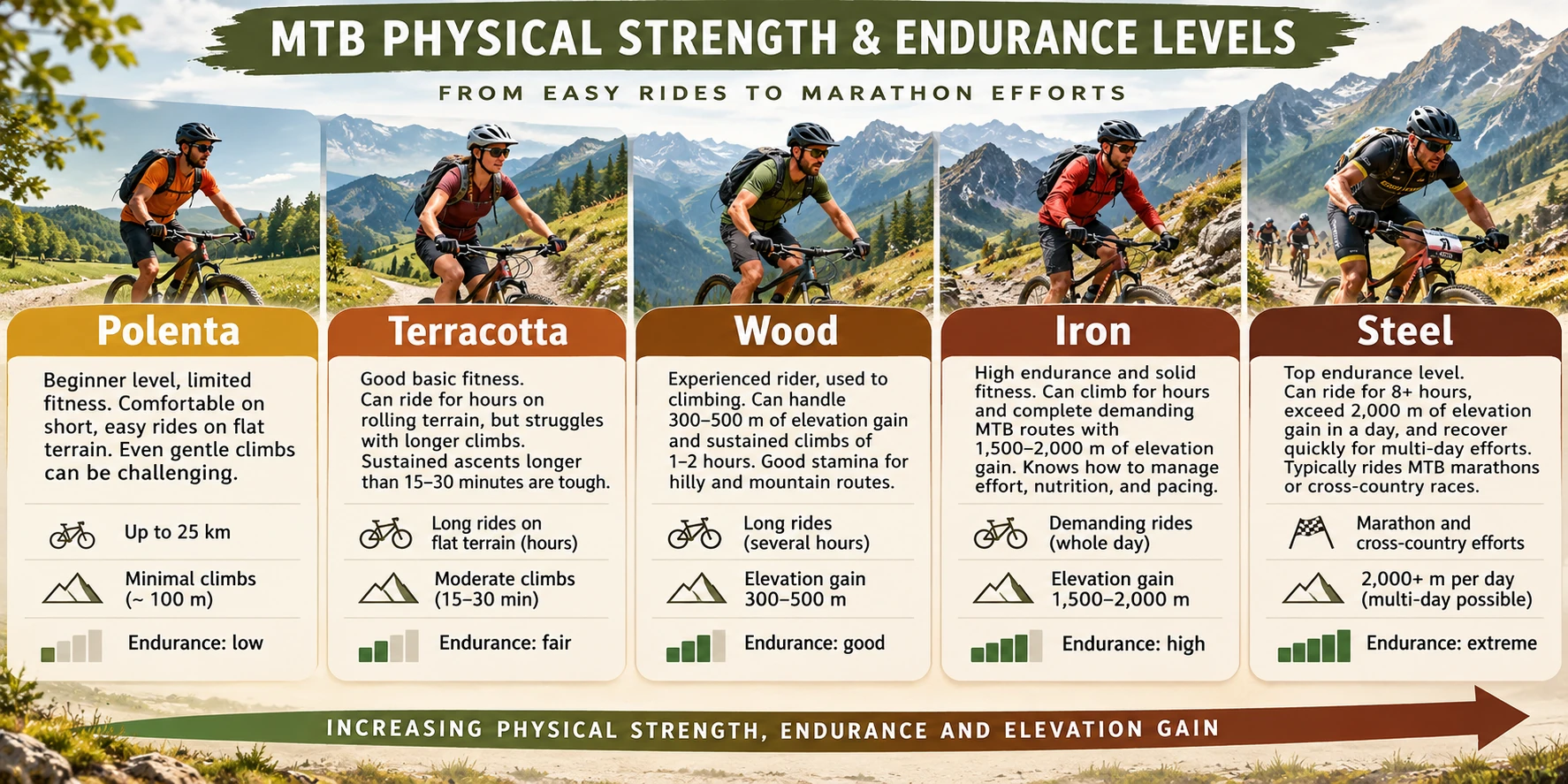
E1 – Polenta
You prefer short, flat rides. More than 20–25 km or a climb of around 100 m can be a significant effort. To improve: gradually extend rides at a conversational pace and add short climbs in an easy gear. Allow time to recover.
E2 – Terracotta
You can ride on flat terrain for several hours but struggle to maintain an uphill effort beyond 15–30 minutes. To improve: alternate moderate efforts and recovery, then gradually add longer climbs at a comfortable cadence and sustainable pace.
E3 – Wood
You’re used to hills and mountain rides with 300–500 m of climbing. Depending on gradient and pace, you can climb for an hour or two. To improve: add climbing gradually, pace yourself from the start, eat and drink on the ride, and recover between harder days.
E4 – Iron
You can handle long rides with 1,500–2,000 m of climbing and know how to pace, fuel and hydrate. To improve: combine endurance rides and higher-intensity sessions with adequate recovery. Set specific goals if you want to improve performance.
E5 – Steel
You can ride for eight hours or more with breaks, climb over 2,000 m and handle demanding days back to back. This profile is common among endurance, marathon and bikepacking riders. To improve: tailor your training load, recovery and nutrition to your goals.
MTB endurance at a glance
| Level | Profile | Typical capacity |
|---|---|---|
| E1 | Polenta | Short, easy rides of around 20–25 km with little climbing |
| E2 | Terracotta | Several hours on flat terrain, climbs of 15–30 minutes |
| E3 | Wood | Around 300–500 m of climbing with relative ease |
| E4 | Iron | Rides with 1,500–2,000 m of climbing |
| E5 | Steel | More than 2,000 m of climbing and demanding days back to back |
Use these figures as a guide. Gradient, surface, altitude, temperature and overall ride duration all affect how hard a ride feels.
How to work out your mountain bike level
Choose the technique level (T1–T5) and endurance level (E1–E5) that best describe what you can do consistently. Combining them gives 25 possible profiles.
| Endurance / technique | T1 | T2 | T3 | T4 | T5 |
|---|---|---|---|---|---|
| E5 Steel | T1-E5 | T2-E5 | T3-E5 | T4-E5 | T5-E5 |
| E4 Iron | T1-E4 | T2-E4 | T3-E4 | T4-E4 | T5-E4 |
| E3 Wood | T1-E3 | T2-E3 | T3-E3 | T4-E3 | T5-E3 |
| E2 Terracotta | T1-E2 | T2-E2 | T3-E2 | T4-E2 | T5-E2 |
| E1 Polenta | T1-E1 | T2-E1 | T3-E1 | T4-E1 | T5-E1 |
- Iron Turkey (T1-E4): strong climber with limited experience on technical trails.
- Wood Goat (T3-E3): confident on mountain trails with intermediate endurance.
- Terracotta Chamois (T4-E2): skilled descender who tires on long climbs.
- Steel Ibex (T5-E5): expert handling and exceptional endurance.
Base your choice on the rides and features you can handle regularly and in control.
Do these levels apply to e-MTB riders?
The technique scale applies to e-MTBs too. Allow for the bike’s weight and how that weight is distributed. When assessing endurance, consider the effort you actually sustained and the assistance mode you used. Motor output, battery range and rider input all change the effort behind a given elevation gain.
How to choose a mountain bike route for your level
Check the total distance and climbing, the length and gradient of the climbs, and the technical difficulty of the descents. Consider obstacles, exposure, trail conditions, weather, expected duration and escape options. Pick a route that leaves you enough energy and control to ride home safely.