
FOX fork setup: air pressure, sag and rebound
- Guide mtb, Mtb life
- October 21, 2026
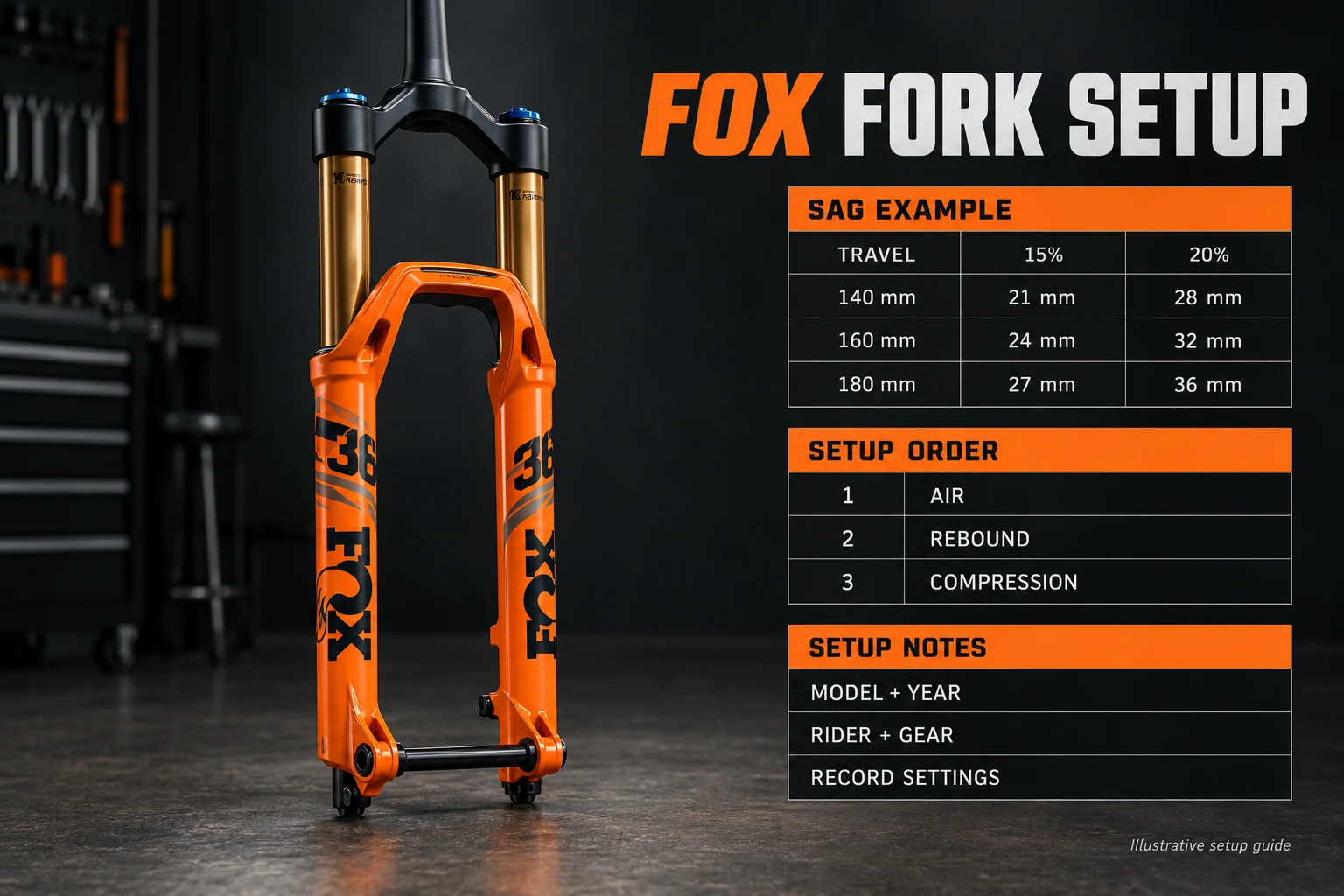
To set up a FOX fork, identify its model, year and damper, use the matching pressure chart, measure sag, then adjust rebound and compression. The explicit numerical reference in this guide is the FOX 2024 manual for 36 and 38 forks. Its settings do not apply to every FOX fork.
The cover is an AI-generated illustration, not a test photograph or an official setup chart. The tables below are accessible HTML text and remain available without JavaScript.
In this guide
- Identify your fork
- Sag table
- Pressure, rebound and compression
- Record your setup
- Frequently asked questions
Model and year come before air pressure
| Information | What to check |
|---|---|
| Model | Full fork name |
| Year and identifier | Product code or serial number in FOX support |
| Air spring | FLOAT, Rhythm or the actual version fitted |
| Damper | Name on the fork and in its manual |
| Travel | Actual configured travel |
FOX 36 or FOX 38 alone does not describe every relevant difference. Do not transfer 2024 manual settings to a 32, 34, 40 or a different damper generation. Start with the FOX technical centre and locate the document matching your product.
FOX 36 and 38 sag table: a 15–20% example
The FOX 2024 manual for 36 and 38 forks specifies 15–20% sag. The measurements below are calculated as travel × percentage, keeping decimal values. This is not an air-pressure chart.
| Travel | 15% sag | 20% sag |
|---|---|---|
| 130 mm | 19.5 mm | 26 mm |
| 140 mm | 21 mm | 28 mm |
| 150 mm | 22.5 mm | 30 mm |
| 160 mm | 24 mm | 32 mm |
| 170 mm | 25.5 mm | 34 mm |
| 180 mm | 27 mm | 36 mm |
Wear your riding equipment, use stable support and let the fork settle in the position specified by the manual. Reset the O-ring against the dust wiper and dismount without bouncing before measuring. Use configured nominal travel, rather than exposed stanchion length.
Air pressure, rebound and compression
| Adjustment | Starting reference | Avoid |
|---|---|---|
| Air | Matching version and equipped rider-weight chart | A universal pressure based only on weight |
| Rebound | Manual guidance for the fitted damper | Clicks copied from another damper |
| Compression | Matching manual procedure | Confusing HSC and LSC with bicycle speed |
| Volume spacers | Service-manual compatibility and limits | Selecting quantity by weight alone |
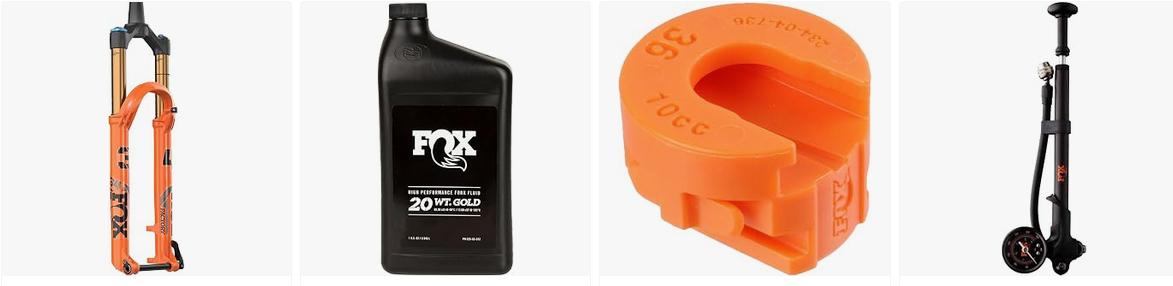
The manual separates pressure and adjuster settings by specification. Consequently, this guide does not offer universal FOX psi or click settings. Identify FIT4, GRIP or GRIP2 correctly; instructions for another damper are not a substitute.
Air pressure affects spring support. Rebound controls how quickly the fork extends again. Compression damping controls movement as it compresses. Where fitted, LSC and HSC act on different suspension movement speeds.
Record the initial setup before testing. Change one setting at a time on a familiar section: this makes it easier to attribute a change in behaviour to the adjustment you just made. Do not force adjusters against their stops or open air chambers without following the specified service procedure.
Table for recording your FOX setup
| Item | Value to record |
|---|---|
| Model / year / damper | Exact identifiers |
| Travel and equipped rider weight | mm and kg |
| Starting pressure | psi or bar, with units |
| Measured sag | mm and percentage |
| Rebound | Clicks and counting reference |
| Compression | Available adjusters and positions |
| Volume spacers | Verified configuration |
| Test | Trail section, observations and single change |
This is a worksheet, not a universal technical recommendation. Have leaks, damage or abnormal operation checked before continuing your setup tests.
Related guide and official sources
- FOX 2024 36/38 manual: scope of the quoted sag values and version-specific charts.
- FOX technical support: find the manual for your fork.
- RockShox fork setup guide: the separate procedure for the other brand.
Frequently asked questions
What sag should a FOX 36 or 38 run?
The FOX 2024 manual for 36 and 38 forks specifies 15–20% of travel. Always check the manual for your particular year and version.
Can FOX 36 and 38 forks use the same air pressure?
No. The charts distinguish fork models and air-spring versions. Use the matching chart, then measure sag with riding equipment.
How many rebound clicks does a FOX fork need?
This depends on the damper and operating pressure. FIT4, GRIP and GRIP2 do not automatically share click settings; consult your fork manual.