Five days of MTB bikepacking across the Alps
- Mtb life
- March 1, 2022
Alta Rezia — words and photographs by Graziano De Maio and Giovanni Casolari
Five days in the Alps: 198 km of trails and 6,743 metres of ascent
With a tent and everything we needed, we set off through Italy, Switzerland and Austria.
This adventure follows the itinerary of the organised Dreilander Tour, which offers luggage transfers and hotel accommodation. We chose to ride independently, carrying our equipment and camping.
Discover the Dreilander Tour with luggage transfers.
Some adventures are planned months ahead; others take shape in a few days, driven by a deep need for freedom. This was one of the latter. When the call comes, I know I need to be ready to say yes or no. My dear friend Giò knows the routine: when I call and say, “I’ve got an idea — are you in?”, he has to decide. Fortunately, his fitness allows him to ask few questions and accept outrageous proposals with a reasonable chance of finishing them.
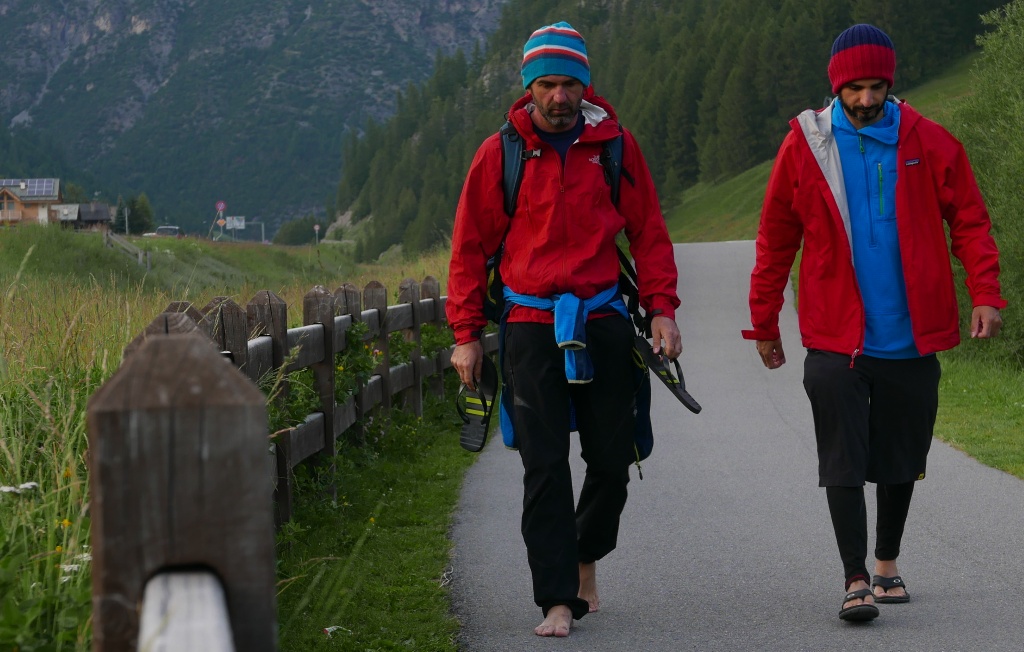
This story begins with the photograph below. That is us. We have reached our final stop, Livigno, pitched the tent for the last time and are walking out for pizza. Of all the pictures from the tour, it is my favourite, the most evocative and meaningful. We walk quietly, thinking back over five days. To our right is Passo Cassana, which took us from Livigno into Switzerland; to our left is Alpisella, on the side from which we returned after crossing Switzerland, Austria and Switzerland again. An MTB bikepacking tour surrounded by the peaks of the Central Alps.
The idea
The idea was simple: follow the stages of the Dreilander Tour, but without luggage transfers or hotel nights. We would carry our own kit and sleep in a tent, travelling about 200 kilometres through Italy, Switzerland and Austria over some of Alta Rezia’s best-known passes and valleys.
We needed to work out whether we could carry a tent, sleeping bag and everything else in a backpack and still climb stages with up to 2,000 metres of ascent. One thing was certain: we would take only the essentials, give up plenty of comforts and pack efficiently.
Rain was another question. Arriving soaked at a hotel, showering and going to bed is one thing. On the organised tour, the hotels even had saunas and laundry services, returning clean, dry clothing the next morning. Good meals and luxurious rooms left you feeling new again. How would our version compare? Arriving in the rain, pitching a tent, changing into dry clothes and then putting wet riding kit back on the next morning was very different — and that is exactly what happened.
There was a simple fallback: if we could not manage, we could always knock on a hotel door and get a proper night’s sleep.
Our route differed from the usual itinerary on the section where we used Val Mora instead of the Umbrail.
Day 1: Livigno towards Scuol, the Cassana challenge and the first rain
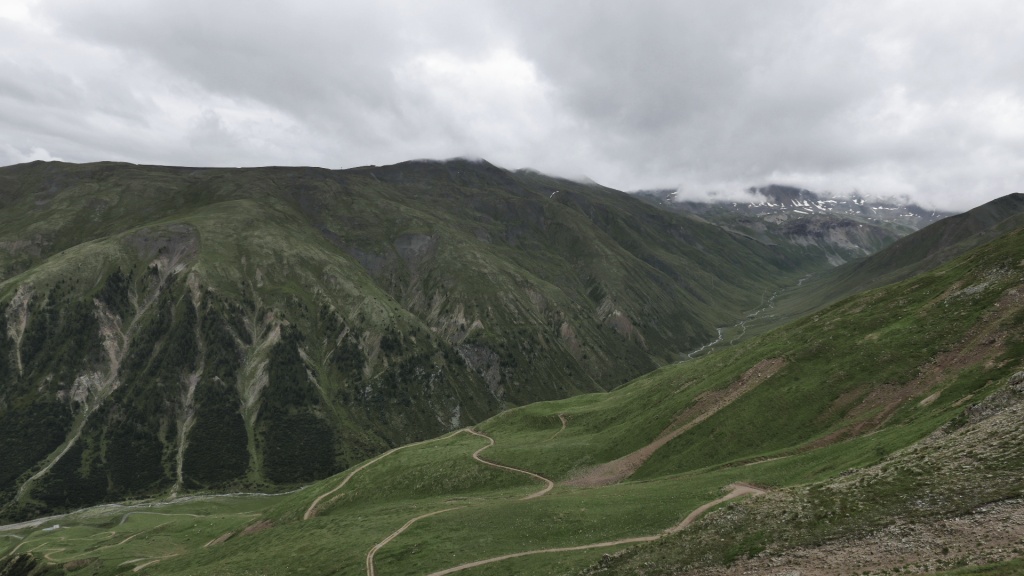
Val Federia and the road climbing towards Passo Cassana.
Planned stage: Livigno – Chaschauna – Zernez – Susch – Lavin – Guarda – Ardez – Ftan – Scuol.
Listed stage distance: 67.9 km; ascent: 1,533 m. We stopped in Guarda.
The evening before departure, we were in Livigno and it was raining hard. The forecast was poor. We had hoped to camp that night, although our equipment was still in the car and the backpacks were not yet packed for the tour. At eleven, we were in Bar Engadina drinking Taneda, an Alpine herbal digestif, while cold rain fell outside. We decided to look for a room. Hotel Bernina stood opposite. I guarded the drinks while Giò went inside; he came back smiling. There was room.
The next morning, only a little drizzle remained, so we decided to leave. By the time everything was ready, it had stopped. Ahead lay Passo Cassana, a wall separating Italy from Switzerland.
We soon became acquainted with the weight on our backs. We had ruled out panniers because we were riding full-suspension bikes over rough trails. Climbing with loaded backpacks and the tent strapped to the handlebars was hard. We had divided the tent between us, poles on one bike and the rest on the other. Often, we had to dismount and push. The sky was dark and threatened rain at any moment.
After a couple of hours we reached the top. Rifugio Cassana was closed, the atmosphere gloomy, with patches of snow here and there despite it being August. At the border, we met a couple climbing from the Swiss side. They were tired and happy to be at the top, the woman visibly exhausted. Their remaining journey was straightforward: a long descent to Livigno. Ours was different. We still had all of Val Cassana, S-chanf and a long, undulating stretch of the Engadin ahead. As we began descending, heavy rain started.
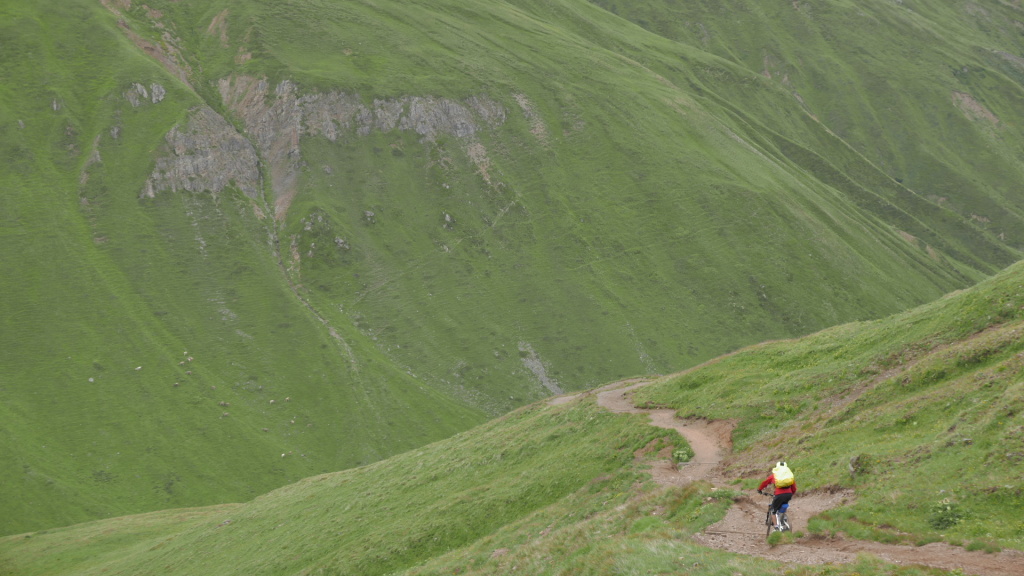
The descent from Passo Cassana towards the Engadin.
We stopped and went into full monsoon mode, waterproofs and all. The descent followed a wild valley with little sign of people beyond cattle fences and a few farms. About an hour later, we reached S-chanf and the Engadin. Soaked and frozen, we sheltered beneath a wooden bridge and ate something.
Here is a confession: I wanted to stop at a B&B and have a hot bath. I asked Giò, “How’s it going? Shall we carry on or stop?” With his innocent manner — I suspect he did not realise Scuol was still several hours away — he replied, “Let’s go, let’s go.” Meanwhile, the sky began clearing. That was encouraging. I agreed: we would keep riding.
We followed the beautiful River Inn through scenery that reminded me of Canada, then left it to climb the hillside. More climbing. At a bar, the sun finally came out properly and warmed us as we ate enormous sandwiches outside. By evening we reached Guarda and decided to stop. Why pitch the tent in a town like Scuol when we could stay in a tiny Swiss village among green hillside pastures?
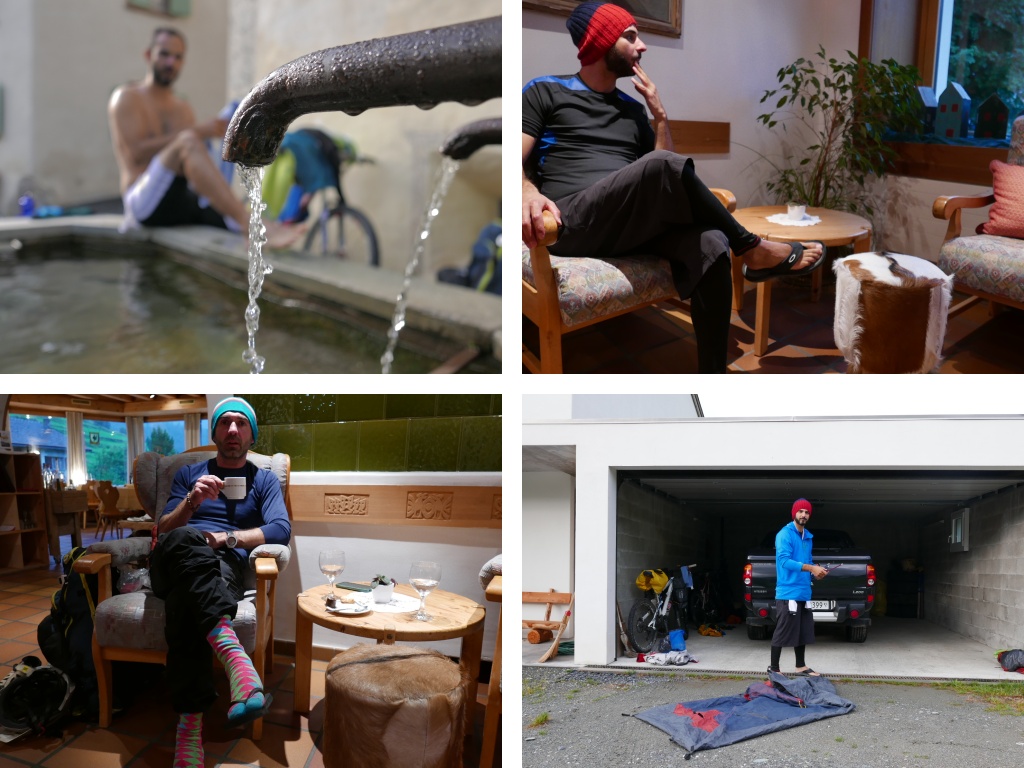
The fountain where we washed, the restaurant that sheltered us and the garage where we slept.
Little lanes, stone houses and one small restaurant. We changed and washed at a fountain, then relaxed on the grass — until a thunderstorm arrived. We went into the restaurant for dinner without knowing where we would sleep. It turned out to be an open garage beside a pickup truck.
After dinner, we explained our trip and asked where we might pitch the tent out of the rain. The restaurateur suggested asking at a nearby farm, perhaps to sleep in the hay barn. At eleven at night, in darkness and rain, we rang the doorbell. A surprised man answered, soon relaxed when he understood that we were harmless, and let us pitch in his garage. Saved.
At eight the next morning, beneath a dark sky with dampness everywhere, came the horrible moment: putting our wet cycling clothes back on. They had certainly not dried overnight. A few seconds of suffering, and we were through it.
Day 2: towards Nauders through the Val d’Uina canyon
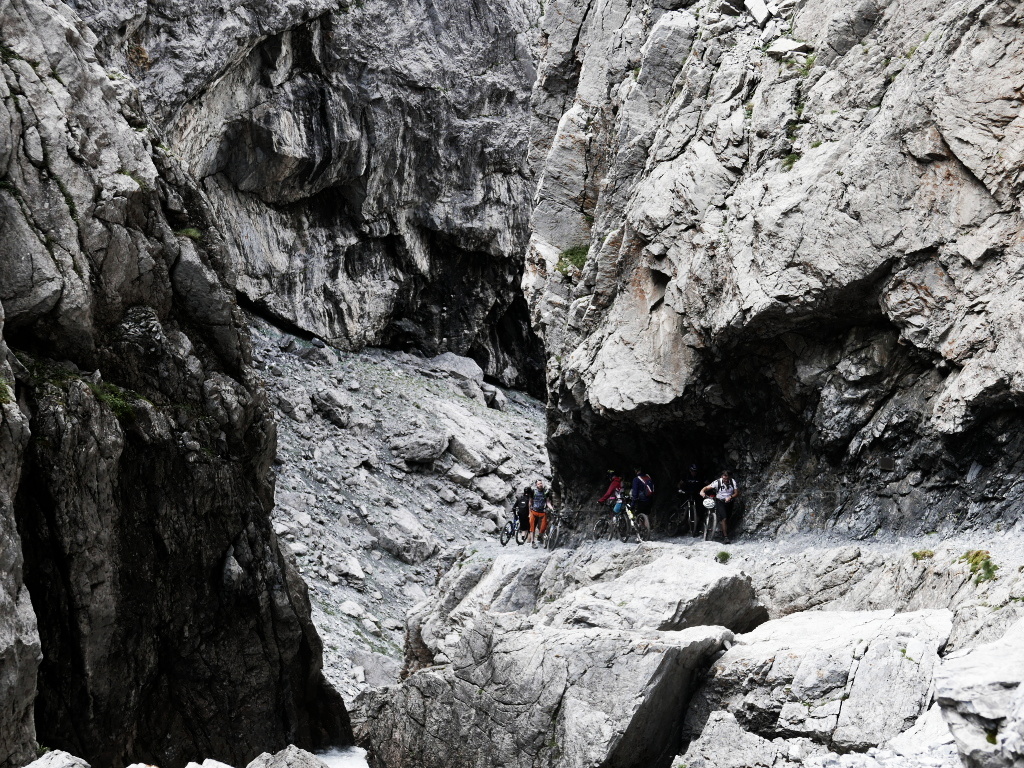
The end of the canyon.
Planned stage: Scuol – Sur En – Val d’Uina tunnel – Sesvenna – Schlinig – Burgeis – Reschensee – Nauders.
Listed stage distance: 56.8 km; ascent: 1,778 m. We stopped in San Valentino.
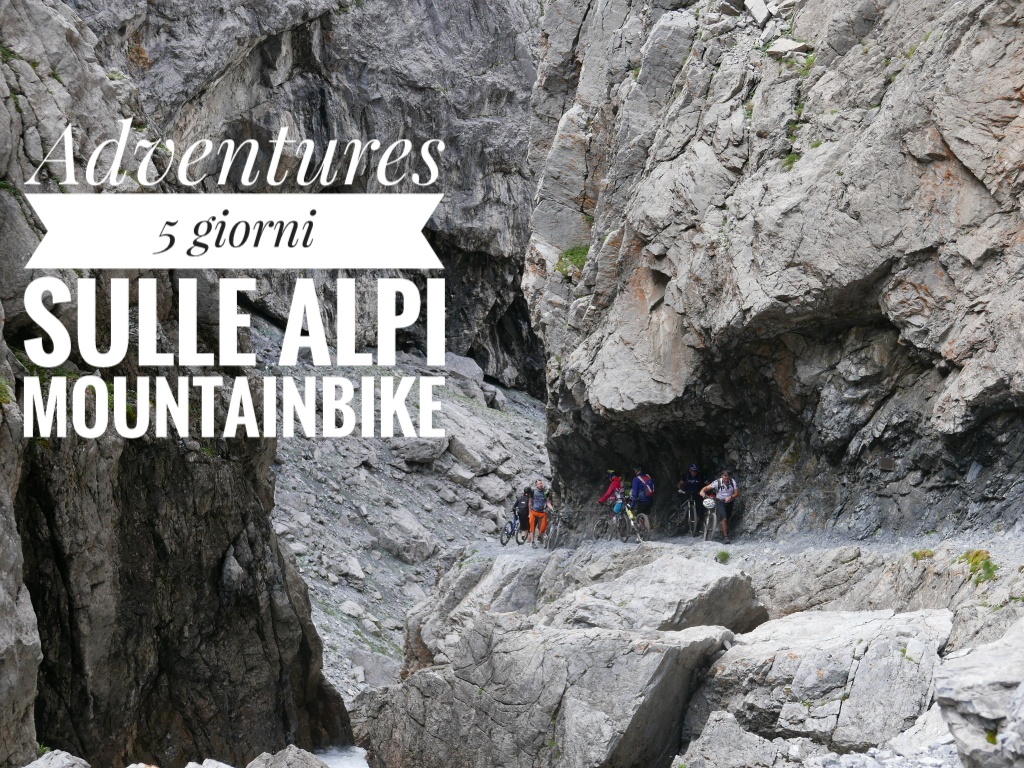
Val d’Uina: a path cut into the rock above a canyon. I could hardly wait to see it, but first we had to climb. We rejoined the Inn and followed it downstream to the valley entrance. After a couple of hours uphill, we reached a hut where we could make out the canyon and the clean line cut into its wall: the trail.
We rested, ate and set off again. The sun was shining and the forecast looked good. Perhaps rain and cold were behind us. Carrying the bikes, we climbed tight bends and walkways to the dramatic path. There were plenty of people, everyone excited. Cables offered handholds beside the broad, well-made path. A few tunnels, countless photographs and about an hour later, we reached the top, where the gorge suddenly opened into green slopes.
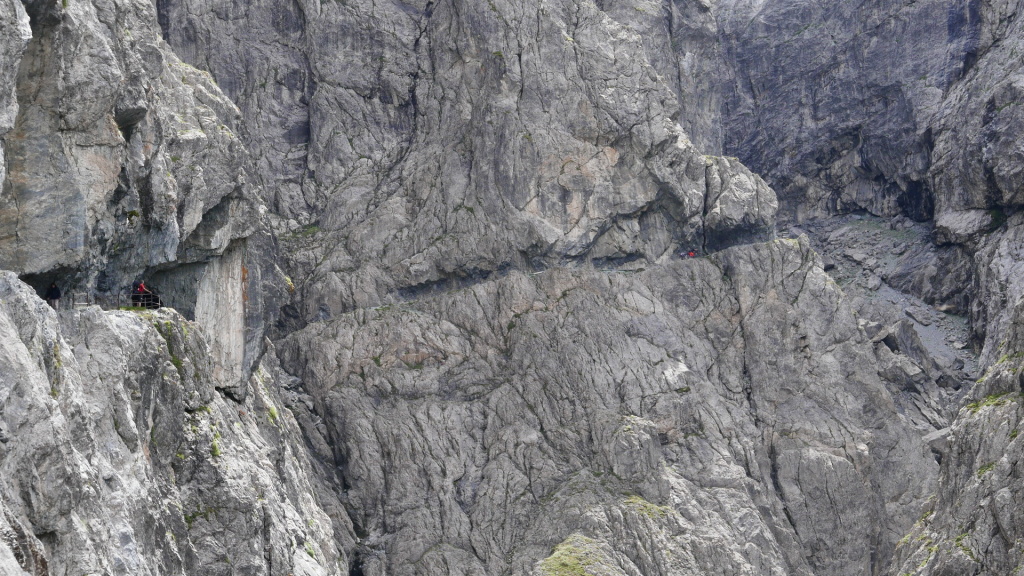
At the end of the rock-cut trail, perhaps from tiredness or hunger, Giò and I argued over an energy bar. Not because we had to share it — he would sooner go hungry himself than let me miss out — but over something absurd. I do not even remember what. We ended up laughing like idiots and set off again. Let me take this opportunity to apologise publicly if I was grumpy, my dear friend.
It was not over. We still had to ride a gentle incline to Schlinig Pass and descend into Val Venosta, back in Italy. The trail lay on the valley floor, with empty space all around us.
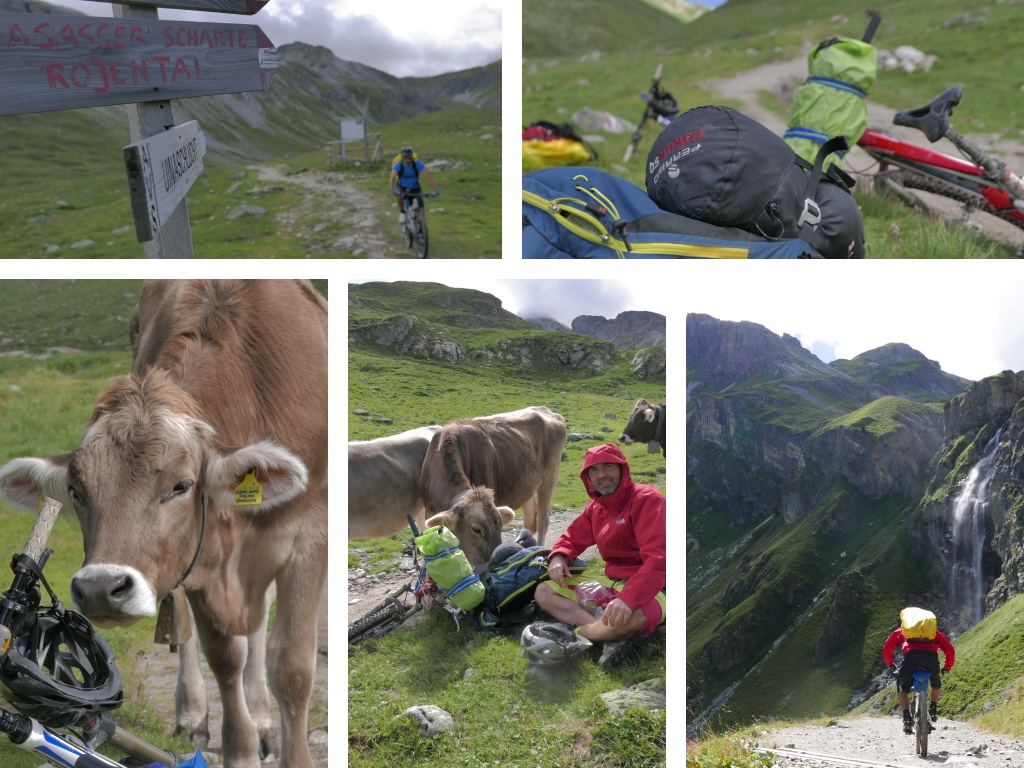
On the descent we took the wrong trail. The GPS was playing up, and we emerged in Val Venosta lower than intended. Now we had to regain height over several kilometres to reach Nauders in Austria.
By San Valentino, we had to admit we were exhausted. We did not know where to pitch the tent and darkness was falling. This was our first and only surrender during the riding stages.
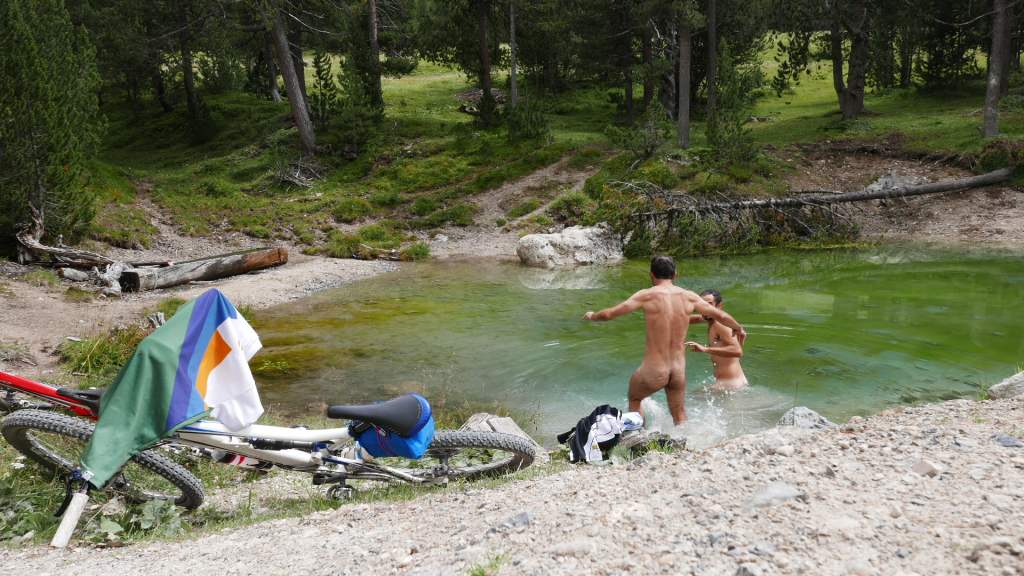
On the descent, a beautiful little lake framed by pines and green meadows inspired us to strip off and jump in.
The sight of a B&B made us positively leap. We asked about a room. What would you do if a friendly man said, “Go upstairs, have a good shower, then come down in your slippers. I’ll make you stew and polenta, then you can have a grappa and go to sleep”? Our answer was obvious.
Day 3: towards Nauders, then back to Scuol
Waking up in a proper bed
Up we got. The room smelled somewhere between a circus and a stable, but we were rested. Breakfast, backpacks on and away: we had to make up the section skipped the previous day. Our legs felt like cast iron.
On paper, the day looked enormous. First climb to Nauders, then higher along the hillside, descend into the Engadin to Scuol and only then begin the main climb towards Val S-charl and Santa Maria Müstair. Our warm-up alone was enough for a full day’s ride.
We had lunch in Nauders, which seemed empty, tidy, clean and slightly artificial. By afternoon we reached Scuol at 1,243 metres, with a pass around 2,000 metres still ahead. But did you know Scuol has thermal baths? And a lovely campsite?
We decided to go to the baths and leave the climb for tomorrow. That freedom was priceless. On the conventional Dreilander itinerary, booked hotels would have been waiting for us. Here, nobody was waiting.
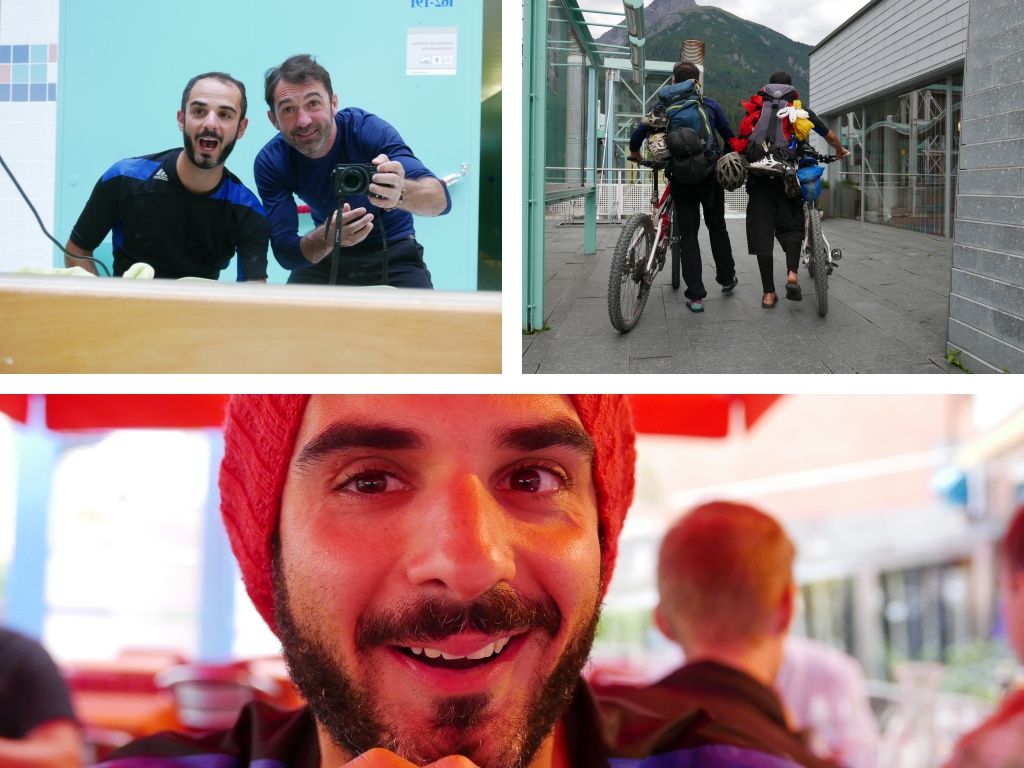
The thermal baths in Scuol.
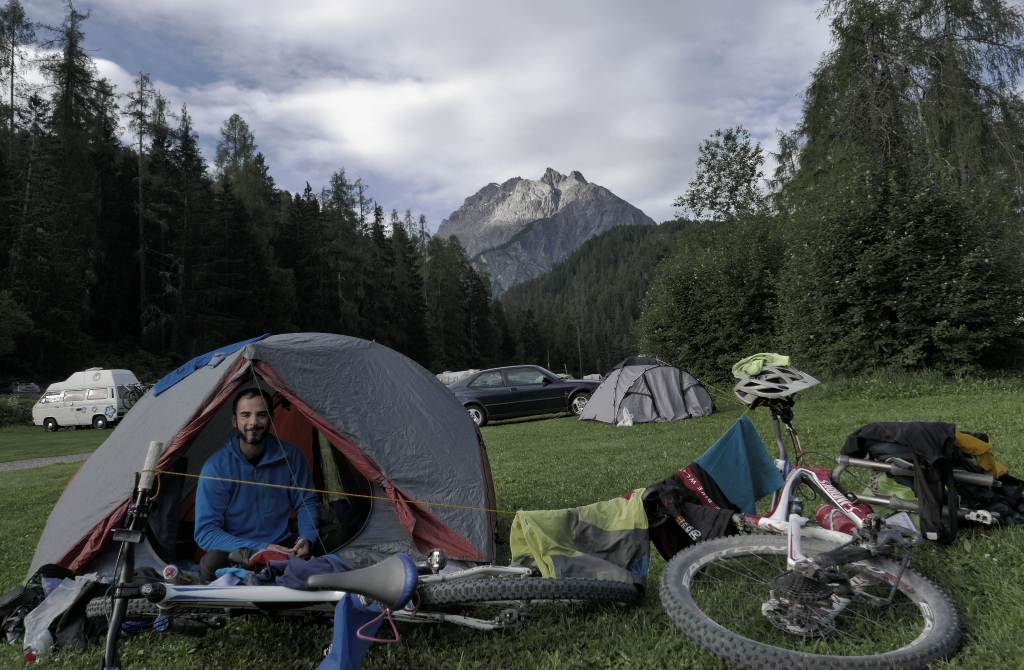
Scuol campsite.
Day 4: Val S-charl to Santa Maria Müstair
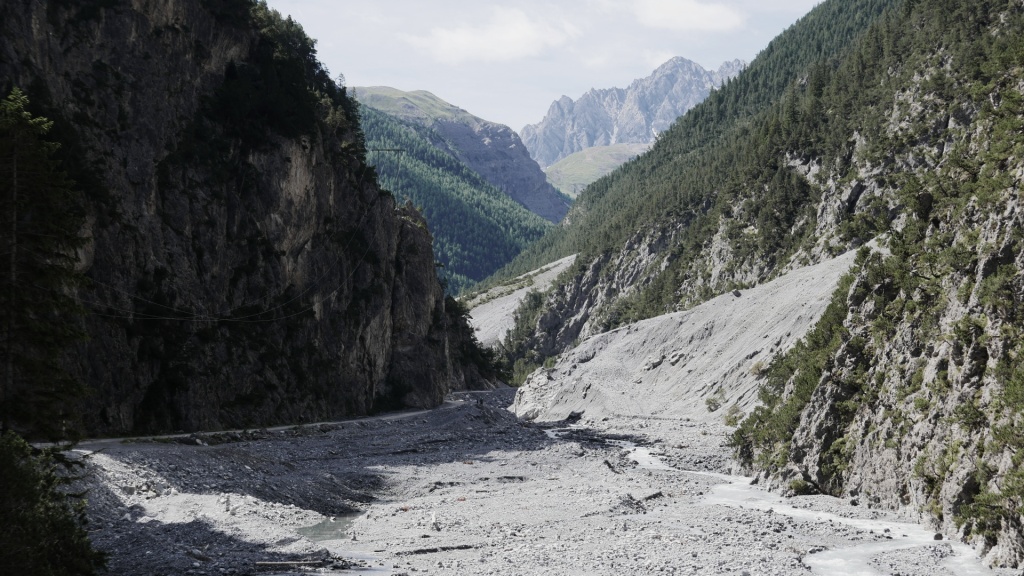
Val S-charl.
This was a fairly quiet stage, without any particular surprises: a succession of valleys, trails and gravel roads beneath Piz Sesvenna. We were struck by the precautions against bears, with reinforced rubbish bins secured by chains.
After lunch and a nap on the grass in the beautiful village of S-charl, we continued to Santa Maria Müstair for a peaceful night at the campsite.
Day 5: Santa Maria Müstair to Livigno through Val Mora and Passo Trela

Santa Maria Müstair campsite.
The previous evening I had used the compass to choose where to pitch among the trees. I wanted the sun to wake us, rather than dampness. It worked: morning sunlight came through exactly between two trees and warmed the tent.
We had a problem, though. Our backsides were sore from the backpack weight and the long hours on the saddle. After careful consideration, I decided something had to be done. The answer, on that trip, was Giofunny’s lip balm. With a pocketknife we cut off a slice each and disappeared to the bathroom to apply it where the saddle rubbed. No laughing: in our improvised solution, it stood in for chamois cream.
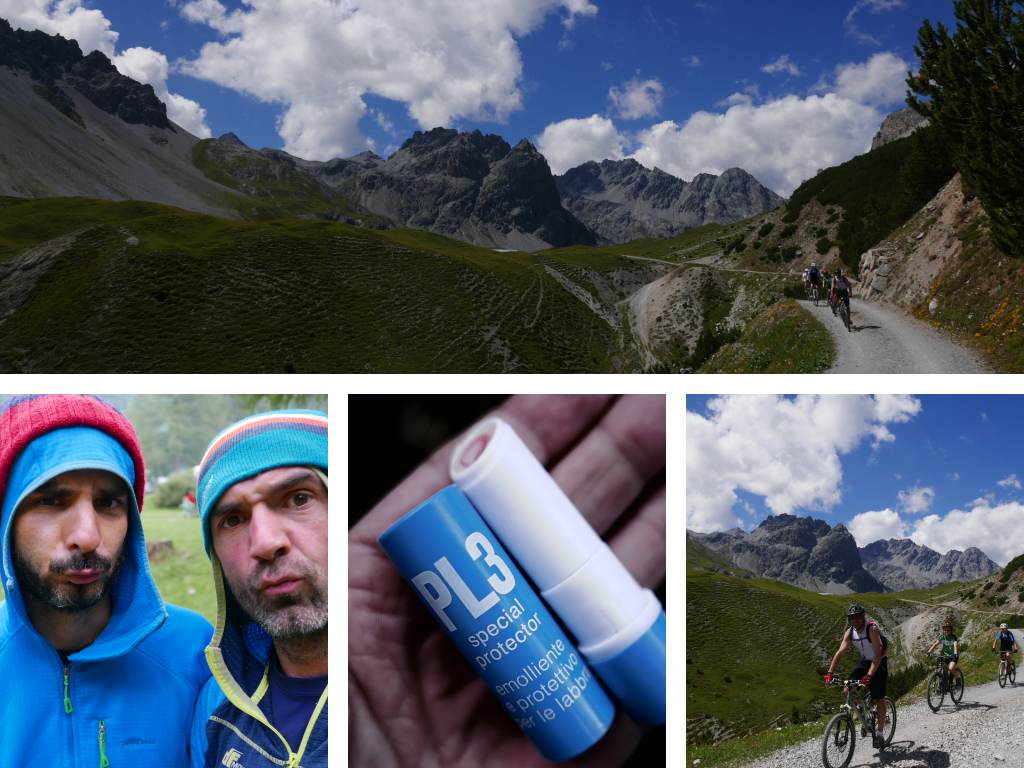
Val Mora and the lip balm that “saved our backsides”.
By now we were experts at packing up. Heavy backpacks ready, we headed for breakfast. This was no place for restraint: cream puffs, juice, pastries, strudel and long coffees.
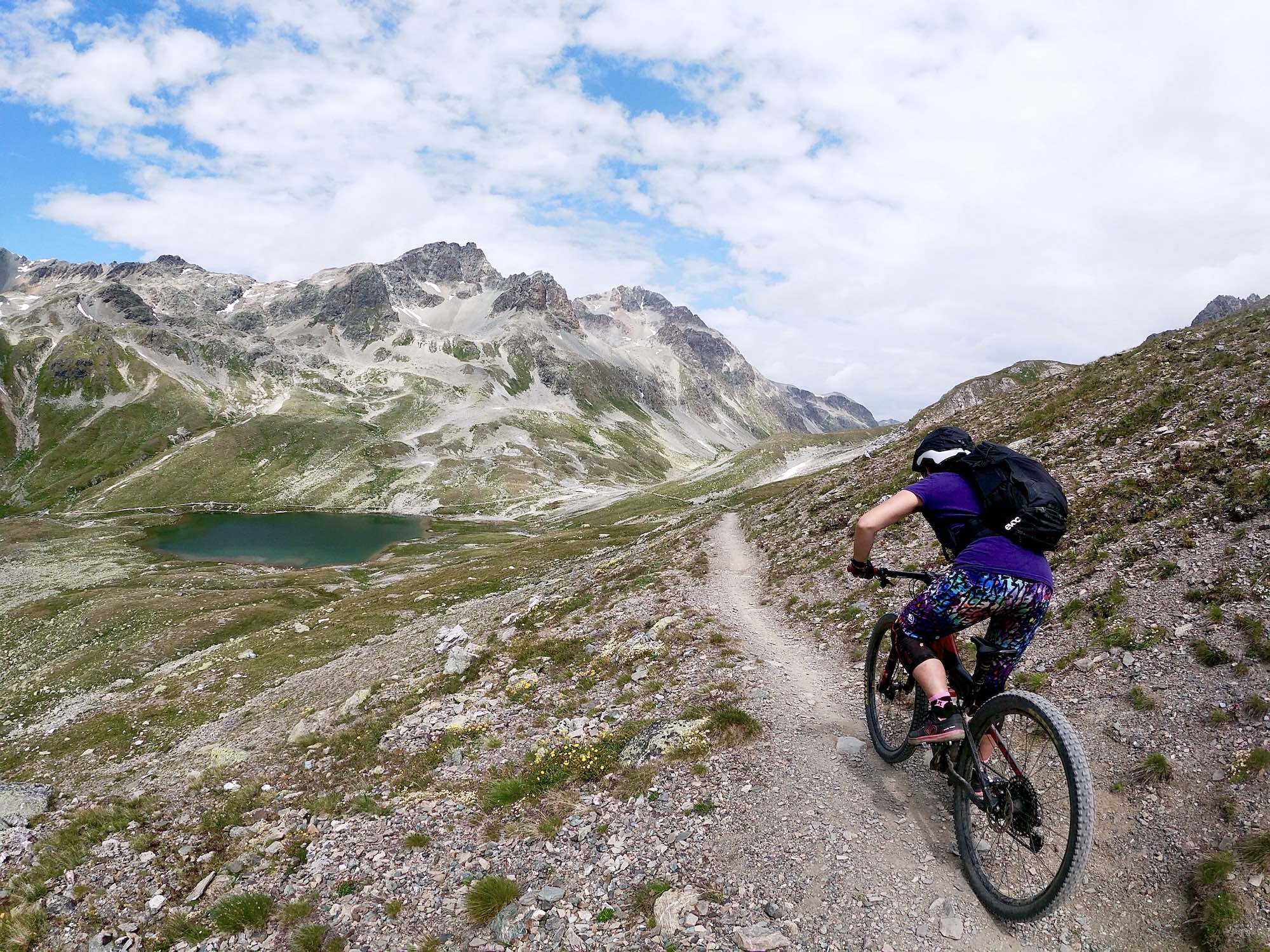
We entered the valley leading to Val Mora, an extraordinary, gentle, pastoral landscape. The climb was long and slow. While we pedalled along the valley floor, a child ran from a hut to meet us. He showed us a fountain holding a bottle of Coca-Cola and plastic cups. His sign read, “One glass, 50 cents.” We accepted the young Swiss entrepreneur’s offer.
Meanwhile his mother played an alphorn, its echo filling the valley. We seemed to have wandered into an episode of Heidi. I could not resist asking her to let me try it.
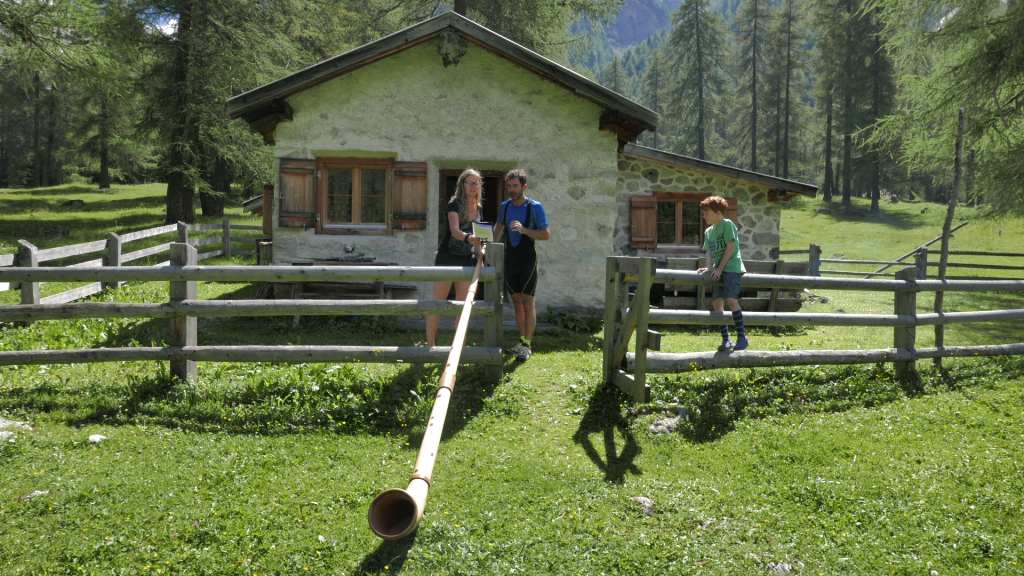
The child selling Coca-Cola and the woman with the alphorn.
From there we began descending. The valley narrowed and the trail climbed onto its side. I felt almost home: soon we would reach the Cancano lakes, with only Passo Trela or Passo Alpisella separating us from Livigno, depending on which route we chose.
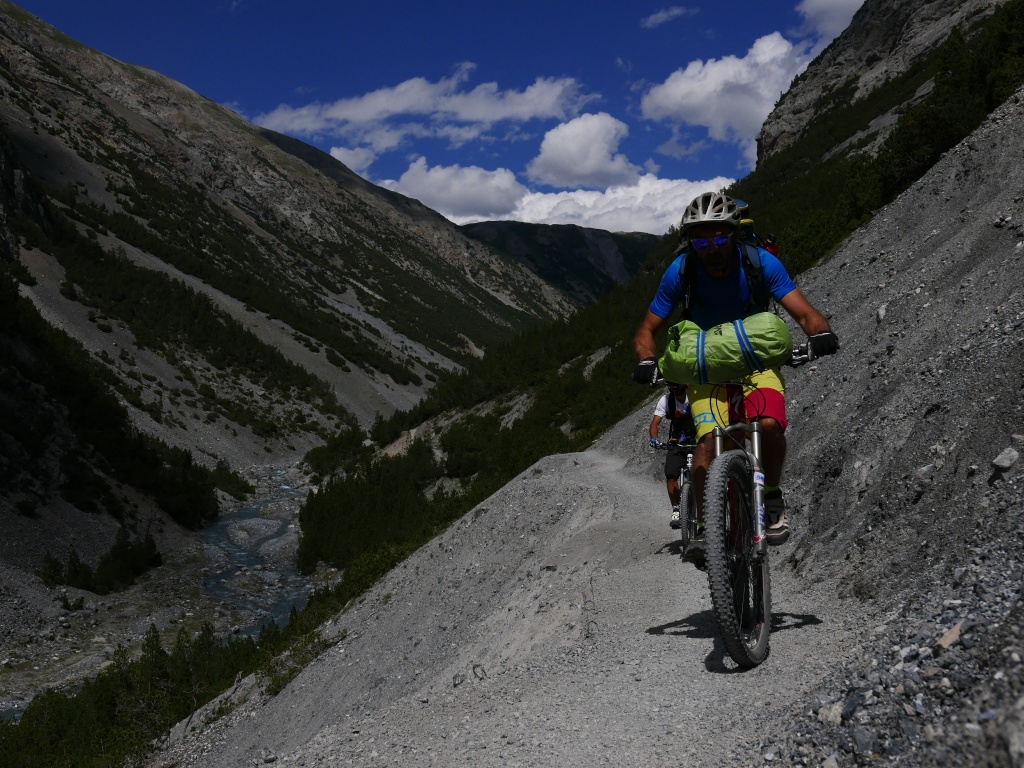
Val Mora, almost at the Cancano lakes.
After two days in Switzerland, we were frustrated with the expensive meals and the pizzas we had tried. The previous evening’s disappointing sausages and stale bread had not helped. Imagine, then, our arrival at Rifugio Val Fraele on Italian soil.
In the early afternoon we sat outside beside Lake Cancano, in sunshine at big wooden tables. A young woman brought the menu. We were so hungry we asked whether she could make a special plate with everything on it: eggs, polenta, bacon, sausage, venison stew, roe deer, marmot… I am joking, but believe me, we ate an enormous amount.
After the feast, a green meadow invited another nap. An hour later we were ready for the final triumph: Passo Trela and the descent to Livigno. The climb through Val Pettini is always hard, even more so with those backpacks. Slowly, we reached Malga Trela and began the climb to the pass.

Malga Trela, run by the Rini family from Bormio during our visit.
Traffic on the descent! From Passo Trela we were finally close to Livigno, with Trepalle visible in the distance. We descended alongside riders enjoying local outings, who were surprised to hear where we had come from.
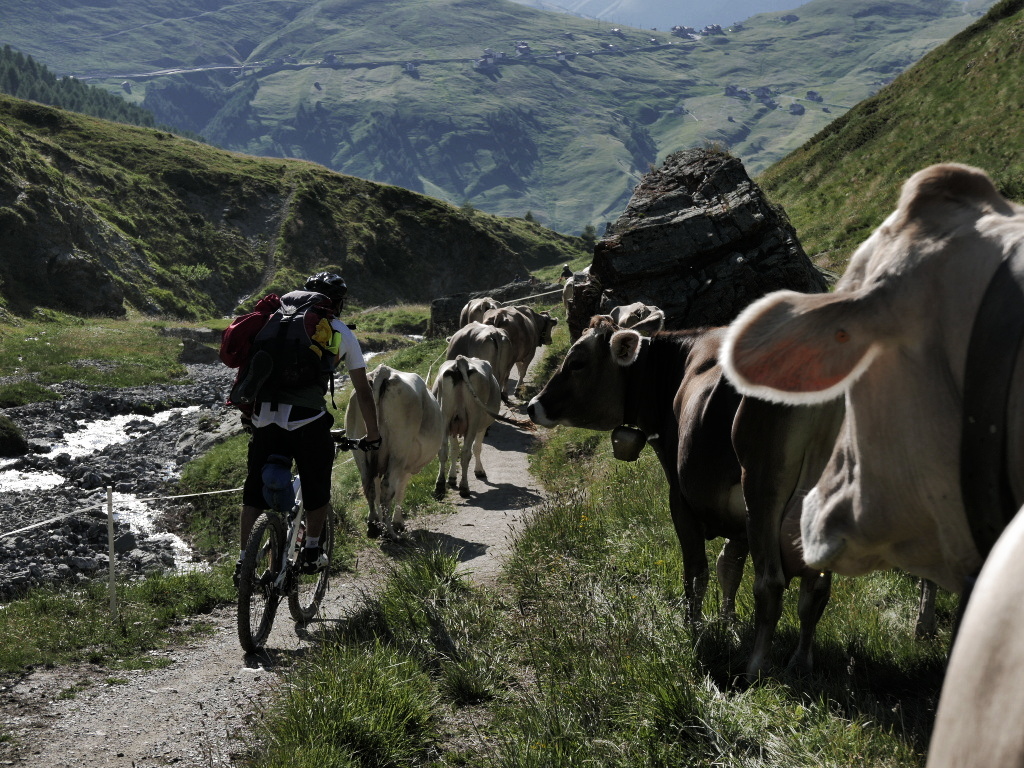
Arriving in Livigno
A fairy-tale trail through the larches finally brought us to Livigno. We rode beside the lake in silence, aware that something which had been only an idea was now real.
There was little time for poetry on arrival. Rain threatened and we were hungry again. It was the busy Ferragosto holiday week, so the campsite squeezed our tent into a tiny space between a fence and a shed. We pitched it once more, showered and set off — as in the opening photograph — in search of pizza, beer and a chance to talk over the adventure.
The story did not end there. Heavy rain began. We ran back to the tent through a downpour and spent the night with a little cat sheltering under the tent beside us, amid thunder, lightning and an apparently endless storm.
Our equipment
The photograph below shows what I carried: a The North Face ski-touring backpack, although I normally use an Evoc; Mavic Alpine XL shoes; a Ferrino Chaos tent; a Specialized Epic Carbon MTB; a Met helmet; spare clothes; Vango waterproof bags; an aluminium bottle; a Swiss Army knife; a compass; wipes; an eTrex GPS; and a breathable The North Face waterproof jacket.
I also carried a Vaude first-aid kit with scissors, plasters, disinfectant, sterile gloves, gauze and closure strips, a tiny Ferrino microfibre towel and an ultralight inflatable sleeping mat borrowed from a friend.
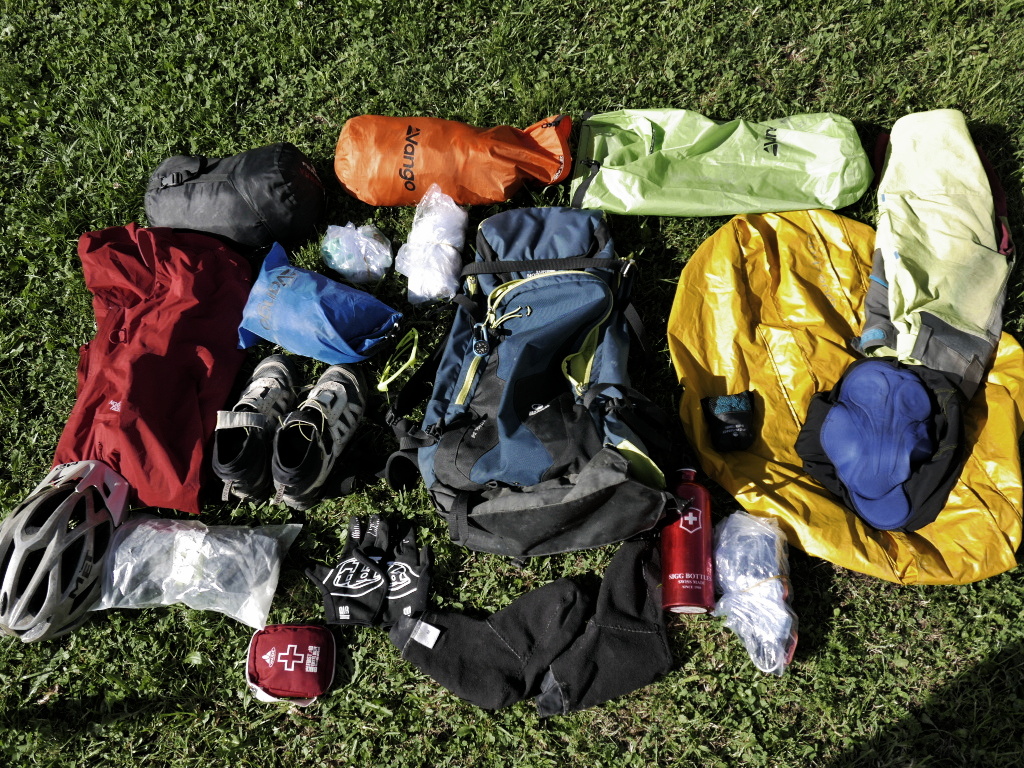
For riders who want the experience with more comfort, the organised Dreilander Tour described above offered luggage transfers and lovely hotels while retaining the adventure of the route. Contact us with questions about our trip.
I hope you enjoyed the story and found some inspiration.
Graziano De Maio — Instagram.