
32-inch downhill wheels: Orbea and Martin Maes’s experiment
- Mtb life
- August 26, 2026
A 32-inch front wheel and a 27.5-inch rear wheel: this was more than a provocative rendering or a show-bike exercise. It was the configuration reported for Martin Maes’s OOLAB-developed Orbea prototype ahead of the downhill World Championships in Val di Sole.
This article translates our report of 26 August 2026. It describes the prototype and expectations at that time, rather than reporting the race result or a production-bike launch.
The bike appeared in Pinkbike’s “Spotted: Martin Maes To Race World Champs On A 32” / 27.5” Orbea Rallon DH”. There is a curious detail: “29” remained in the URL, but Pinkbike corrected the article after publication. Maes’s rear wheel was a 27.5-inch.
The interest was not that it announced the next standard — it was much too early for that — but that an extreme idea was heading for the severe test of UCI downhill racing on Val di Sole’s Black Snake.
More than a Rallon with a bigger front wheel
Orbea had not simply put an enormous wheel into an existing bike. The aluminium frame was an entirely new prototype for exploring geometry, kinematics and stiffness.
According to Pinkbike’s observations, it used a split-pivot layout with two main-pivot positions and two shock mounts to alter progression. A bolted structure allowed bottom-bracket position changes. Several down-tube mounting points accommodated a plate intended to adjust frame stiffness.
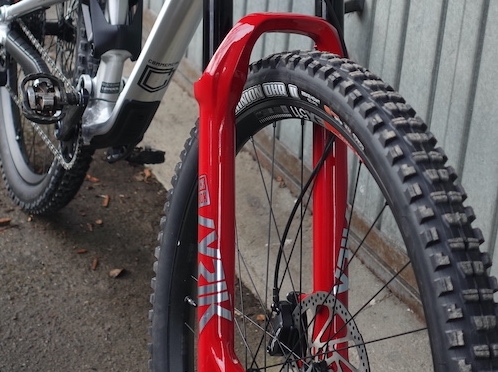
The fork had 200 mm of travel, with Fox 40-derived internals, modified lowers and extensions to accommodate the 32-inch wheel. The prototype Oquo UNCODED rim used 32 spokes, a DT Swiss hub and a Schwalbe Magic Mary Gravity Pro tyre. The front rotor remained 203 mm.
Maes had reportedly completed only about ten runs on the prototype at the time of the bike check. This was a racing laboratory rather than a near-catalogue product.
Why a 32-inch wheel might make sense in downhill
A larger wheel approaches an obstacle at a shallower angle. In simple terms, it can roll over holes, rocks and roots more readily, hold speed on rough ground and provide greater stability. The theoretical attraction on a steep, fast, battered track such as Val di Sole is clear.
The 27.5-inch rear wheel reveals the other half of the project. It keeps the rear more compact and manoeuvrable, gives the rider more room on steep ground and limits the increase in the bike’s overall size. It is a mega-mullet in a literal sense: maximum rollover at the front, agility and freedom of movement behind.
Cockpit height had also been addressed. A lower stem and handlebar reportedly left Maes’s hands only 15 mm higher than with his 29-inch front setup. Judging the project solely by wheel diameter would miss the importance of the complete geometry.
The advantages have costs
Bigger does not automatically mean better. A 32-inch wheel adds mass and inertia, needs dedicated components and may make direction changes slower. Rim, tyre and fork must withstand downhill loads without making the front end heavy or imprecise.
Rider proportions matter too. Maes is tall enough to manage such a front end, but the concept will not necessarily suit shorter riders. The work to lower the cockpit shows that wheel clearance and overall size are significant constraints.
Other questions take longer than a single timed run to answer: tyre availability, rim strength, spare parts, cost and the actual benefit for a bike-park rider without an engineering team.
Revolution or experiment? An experiment, for now
Each new wheel diameter revives the argument about genuine progress versus another standard to sell. The honest response here was to withhold judgement. A 32-inch wheel was neither an inevitable future nor something to dismiss automatically as publicity.
Elite downhill racing allows a solution to be tailored to one athlete and measured on extreme terrain. The original report noted Neko Mulally’s earlier Sea Otter downhill win on a 32-inch front wheel and attributed to Pinkbike the expectation that Maes would be the first to race this kind of mega-mullet in a UCI-sanctioned downhill event. That was a pre-race claim, not a result established here.
The most useful outcome might not be widespread adoption. A larger front wheel could prove effective only on particular tracks, for riders of particular heights or with smaller rear wheels. It might become a specialist option among many race-bike adjustments.
That is why the prototype deserves attention: it shows downhill still experimenting. Whether the idea has a commercial future requires evidence beyond the existence of a race prototype.